Camels and Cosmodromes
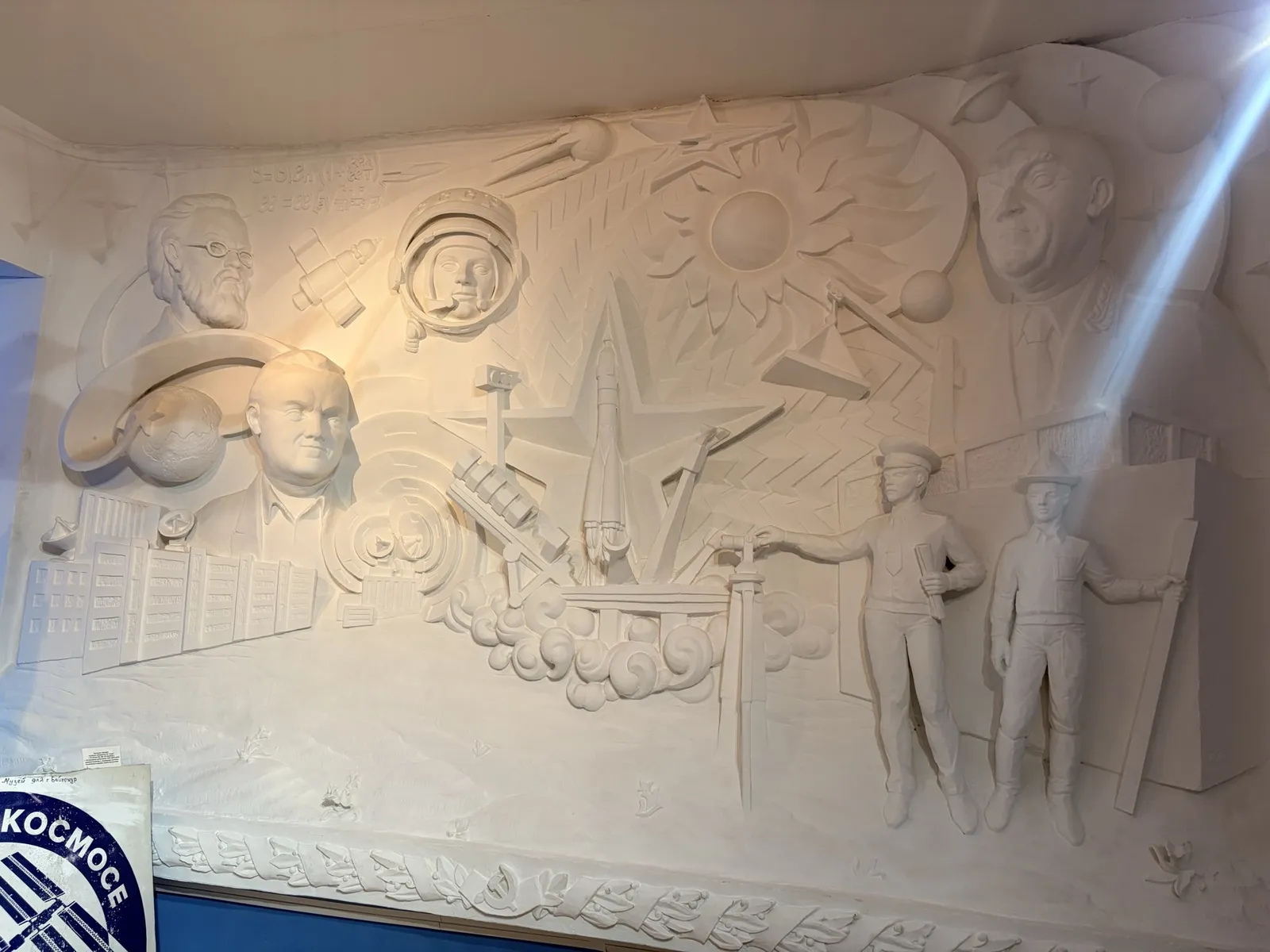
Korolev, chief designer of the space program · Yangel, chief designer of the ballistic missile program · Gagarin, first human in space, 1961
The year is 1954. In the decade since World War II, two superpowers have directed their undivided concentration on the development of nuclear weapons. Your name is Sergei Korolev, an engineer placed in the centre of the Soviet missile program. You had been sent to one of the most brutal Gulags sixteen years prior during the purge. You were released six years into your sentence, when the Soviets realized imprisoning all your engineers wasn’t great for military development. You have been dreaming of space even before your captivity, but that’s not what the government released you for. Perhaps back in the Gulag, looking at the night sky was one of your few moments of reprieve.
You’ve successfully reconfigured Germany’s V-2 technology after the Soviets swept into defeated Germany, and stripped its rocket program for information. In theory, you’ve created something powerful enough to destroy American cities, and make your superiors very happy. Yet one question remains: “How on earth do we actually get this bomb there?”
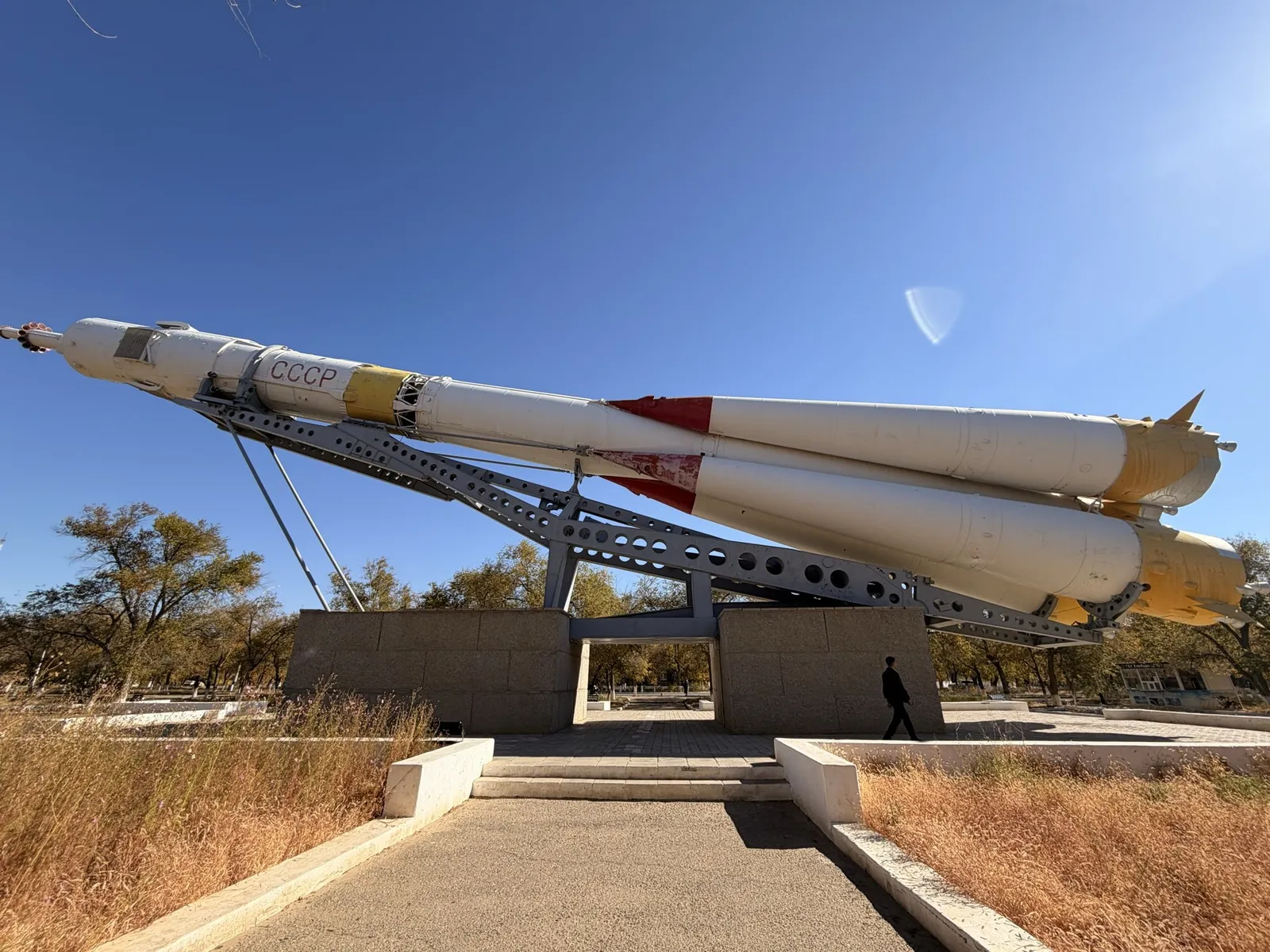
Your superiors push your nuclear payload to 5 tonnes, almost double your initial design, and formally task you to develop the R-7 intercontinental ballistic missile. The Soviets do not want to appear small in any aspect. Your missile is not only incapable of making it to America, but is now gigantic. You design the R-7 Semyorka, a beast with a central core surrounded by four boosters, an absurd amount of rocket power for the time. Feeling pretty confident, you decide to test your luck. While corresponding with the government, you sneak in a report by your colleague, Tikhonravov, essentially saying: “Considering the rocket is powerful enough to get a nuclear payload to America, couldn’t it also put a satellite into space?”
This is not the first time you and Tikhonravov have tried to interest the Soviet leadership in satellites. But it is the first time it worked. The next year, the scientific study of artificial satellites becomes respectable, and the U.S. publicly announces they intend to launch their own. Finally, you get formal permission. Kinda. Superiors still visit you to ensure you don’t forget your main mission to build that intercontinental nuke. Around this time, the Soviet military realized they need a new place to test this monster. They settle on the Kyzylorda region in the Kazakh USSR, and build the space city known today as Baikonur. A vast, mostly destitute region that became the historic birthplace of humanity’s space age. And you, Sergei Korolev, go from digging gold in subarctic conditions with malnutrition, scurvy, and missing teeth, to being the central engineer who turned man’s dream of space into reality.
Reality can be stranger than fiction. One of humanity’s most monumental achievements had been streamlined by engineers who barely had a moment to breathe after torture, in a region so repressed, so traumatized, that a contemporary district official reported only 15–20% of its population had survived the man-made famine just two decades prior. Baikonur bears a staggering legacy, one simultaneously so extraordinary and heavy, it’s hard to reconcile.
Going back to the modern day, Baikonur remains active, functioning as both a launch site, and a preserved historic capsule of its grandest era. This is what it was like to stay there in 2026.
The Journey
Getting to Baikonur is no easy feat, even within its home country. You first arrive in Kyzylorda, one of the country’s lowest-income regions. Their tiny local airport only has scheduled flights within Kazakhstan. The city’s traumatic history still hangs in the air, but generally the city does seem to be in an upswing. Yandex got bombed before I landed, so most of the ride-share services were down. Interestingly, the Russians were legally required to have a separate data centre in Kazakhstan for their operations there. Clearly this regulation was not taken seriously as I, along with most of Kazakhstan, found ourselves revisiting the concept of taxis.
My driver was a kind patriot of his city. He’d served in Almaty, yet still came back. He proudly gave me a tour of his town. Military service here is technically mandatory for men, but with the right wealth and connections, there are many ways to avoid enforcement. In Almaty, it’s quite uncommon to see men in military uniforms. In Kyzylorda, many of the young men I saw were dressed in camo green.
The next morning, a car was sent to pick me up. The journey was three hours long, or would have been closer to four if my driver hadn’t been insane, bravely overtaking into oncoming trucks with a second to spare. There wasn’t much to window watch, except destroyed cars the government propped up onto pedestals along the highway (to deter dangerous driving).
I imagine when the Soviets chose the Kazakh USSR as the location for their nuclear (and later space) program, they did not anticipate an impending collapse. Alas, Russia found its precious complex inside a sovereign Kazakhstan. To compensate, Kazakhstan signed a voluntary treaty to lease it back to Russia until 2050 for $115 million per year. From a larger perspective, this seems to make sense. But the more you zoom, the stranger Baikonur’s legal status becomes, as the city increasingly operates under a strange overlap of Kazakh and Russian authority.
To visit Baikonur, you need to send an application to the Russian government for approval. As of this summer, Russia has stated it will no longer approve applications from “unfriendly countries”. As someone with a Kazakhstani passport, I am considered to be from a “friendly” country.
Near the cosmodrome entry point, I was told to change vehicles. We passed a large poster where Putin and Tokayev shake hands. Surprisingly, this is the last Putin imagery I saw. Instead, the cosmodrome seems to follow its own religion of what I nicknamed the holy trinity: Korolev (from the opening anecdote), his arch-nemesis Yangel (more on him later), and Yuri Gagarin, first man in space. The Soviets could not have lucked out more with Gagarin. Slavic, straight teeth, great jawline, psychologically strong, a naturally charming demeanour. The perfect man to parade around if he were to survive re-entry. Though they never would have risked a man unfit. Korolev was said to be very aware that the first man in orbit would become an enormous propaganda asset.
The entry checkpoint was largely uneventful. The guide prepared all our documents for us, we handed furrowed-browed military men our passports and paperwork, and I unceremoniously opened my suitcase for a search. Finally, I had entered Baikonur.
Day One
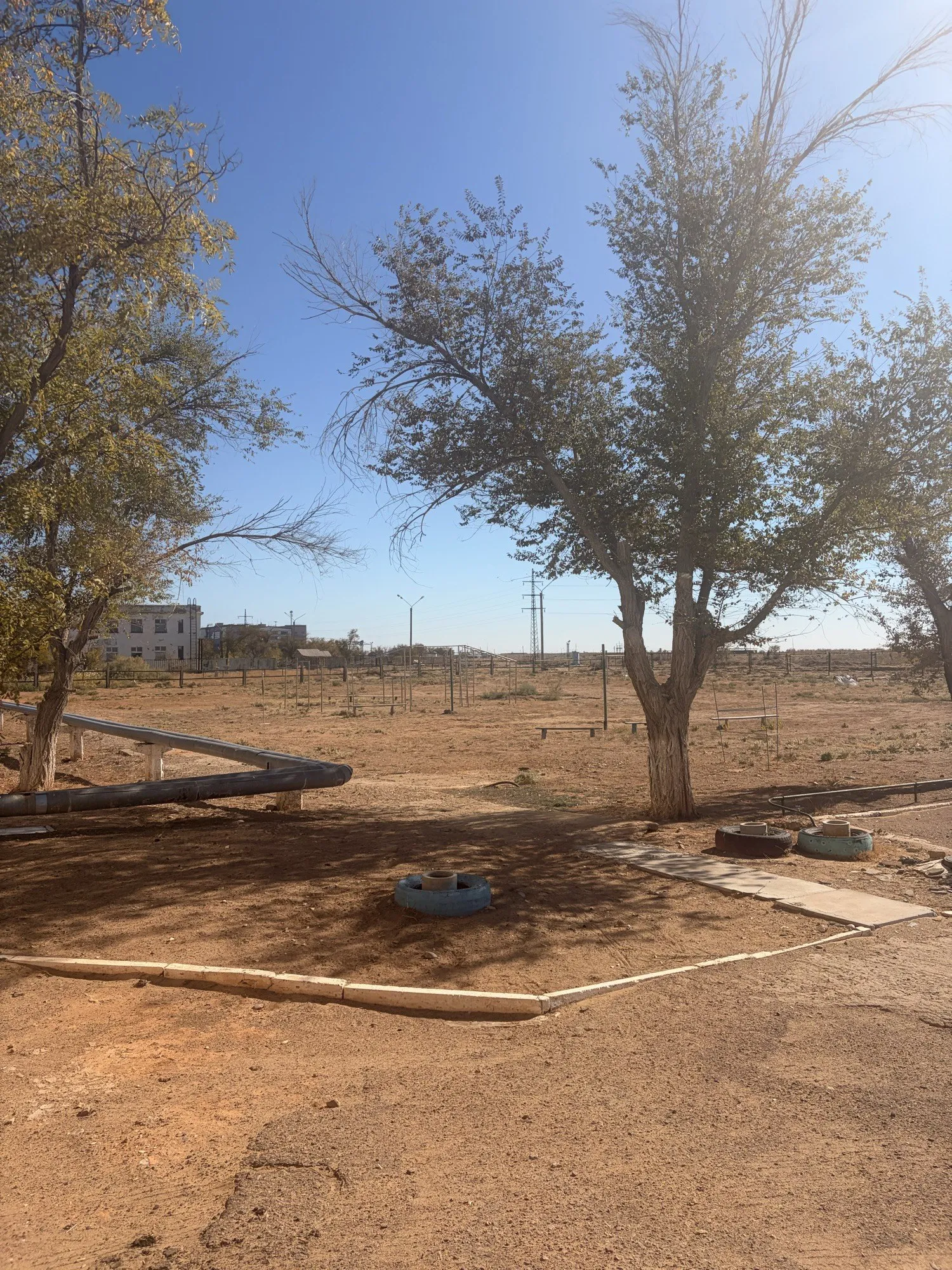
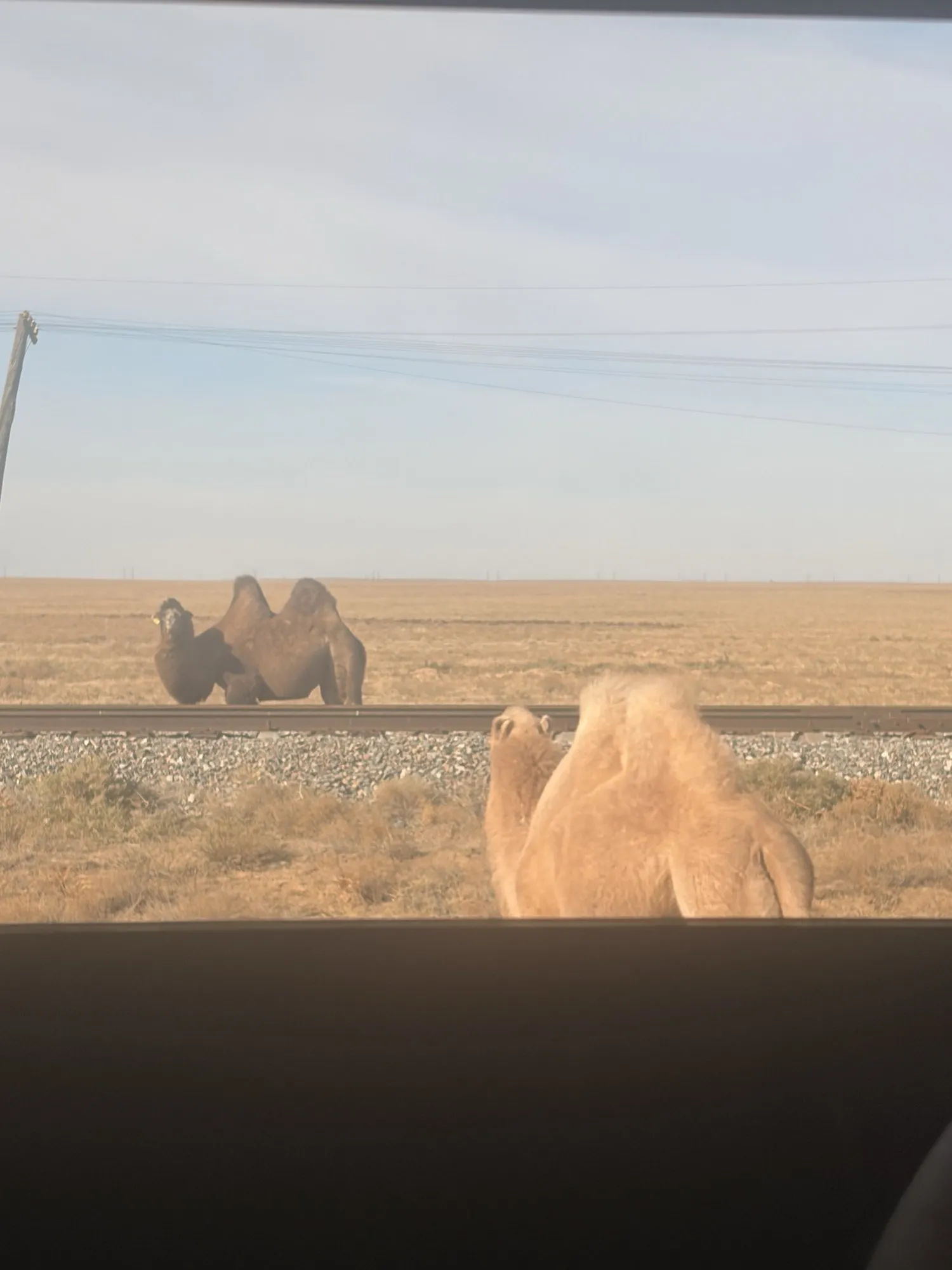
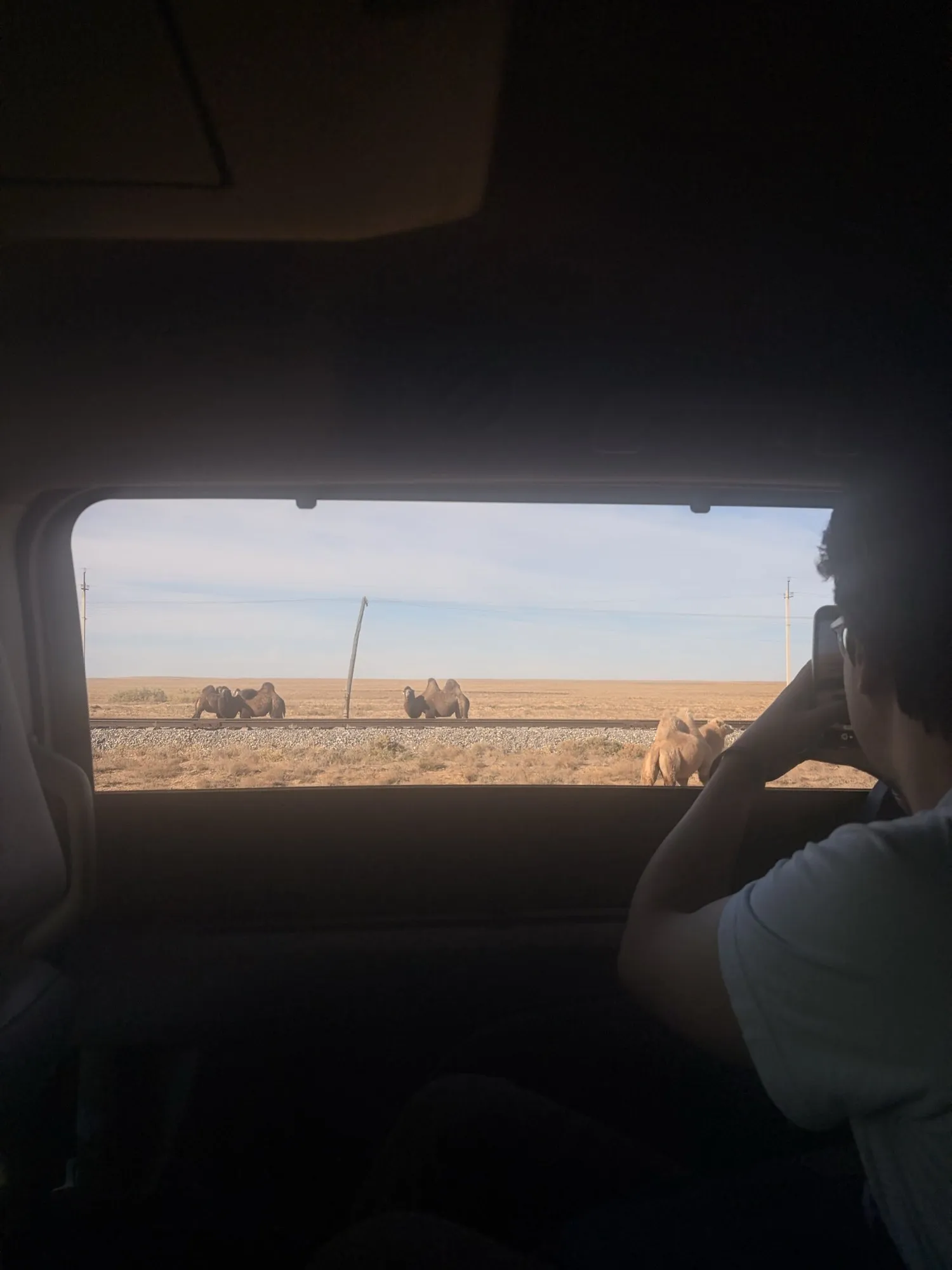
When I imagined Baikonur, I had thought I would immediately see vast decaying structures, Soviet propaganda, and a small city around a spaceport. All of these did exist, but roughly as distant from each other as stars in space. Our ride from the entry point to our hotel took twenty minutes. Generally, I saw a few groups of camels, and a herder on a horse. I was pretty confused by the herder. Nomadic pasture seems to have really reclaimed its land. I was told the animals don’t even react to the sound of launches anymore.
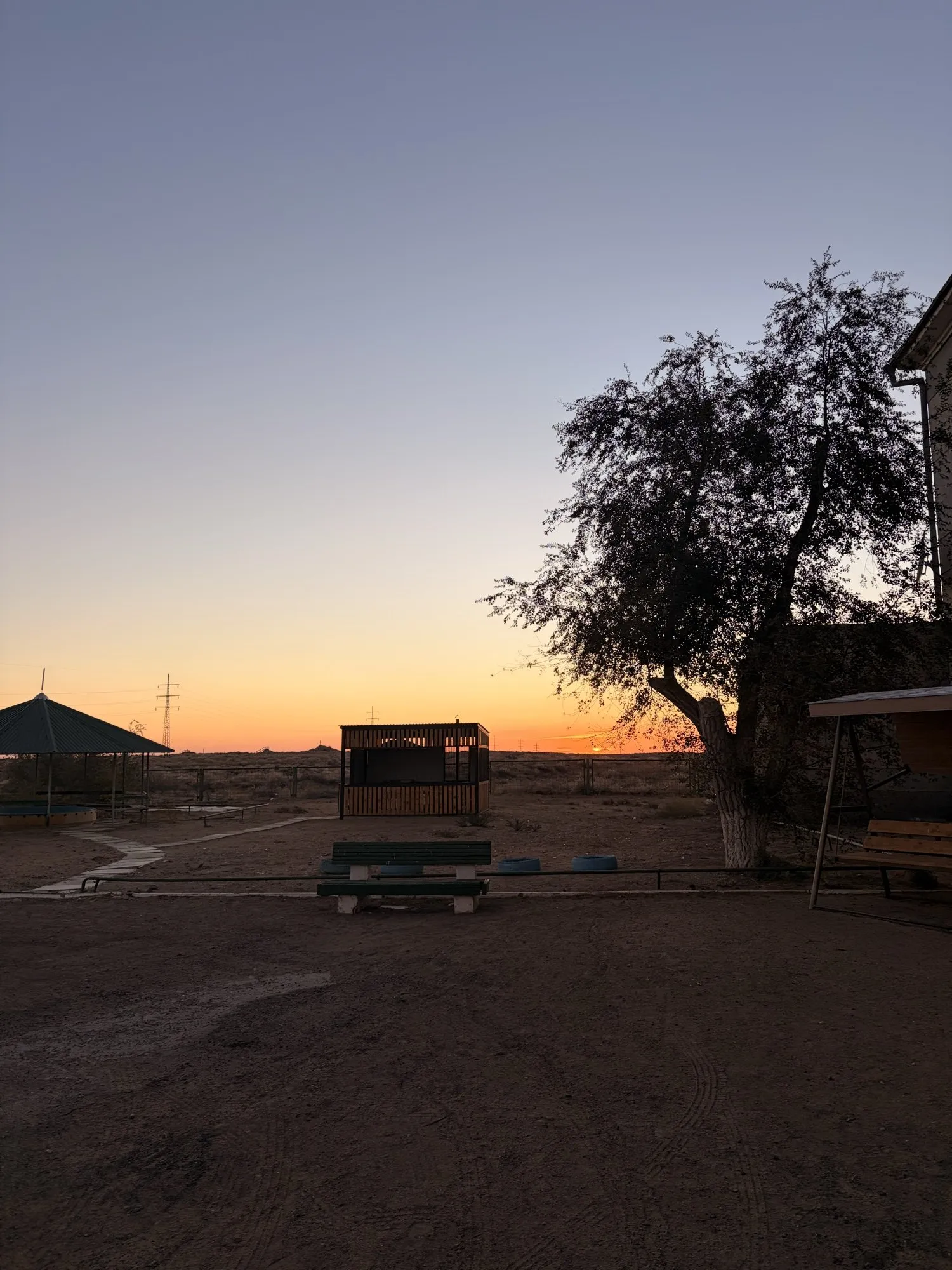
We stayed in an abandoned military town called Site 43, originally built to house the personnel testing the R-16 intercontinental ballistic missile nearby. The town is abandoned and extremely decrepit, with the exception of two semi-working buildings; the dormitory we stayed at, and a cafeteria that feeds nearby workers. The dormitory was the same building Yangel stayed at (one of the holy trinity). They built that entire town just to support the military and personnel for his missile program.
Yangel got off easier than the other engineers who pioneered the Soviet space age. He had avoided imprisonment in the Gulags, though came dangerously close. His brother had been executed in 1938 during the purge for “counterrevolutionary activity”, bringing attention to Yangel, who had been accused of being the son of a kulak (a wealthy peasant). He traveled to his home in Siberia during the middle of winter, before returning to Moscow with his documents to attempt to prove his innocence. It’s unclear if the documents actually saved him from a harsher fate. Perhaps even being away benefitted him, as Moscow shifted its attention to other investigations. His brother, like many, was posthumously rehabilitated in 1957, when a military tribunal overturned his execution and conviction as baseless. A grim reality of what the purge was really about.
Following this terrifying ordeal, Yangel’s career continued relatively uninterrupted. He had built an impressive career in aviation, and was assigned to the Soviet ballistic missile program in 1950. By that April, he had become head of the department responsible for rocket instruments, despite having no background in rocket engineering. By 1952, Yangel was promoted to Korolev’s superior. There started the beef between the two.
It’s hard to know for certain why Yangel and Korolev immensely disliked each other. Initially, it’s thought to have started as a power struggle. By the time Yangel had been promoted to director, Korolev had already made a career as an accomplished engineer. Neither wanted to take orders from the other, reaching a point where both refused to even speak, communicating only through deputies. Personally, I think both men were in positions where their lives were very circumscribed. While they did seem to have incompatibilities, I believe their feud was one of the only “safe”-ish ways for these men to express discontent and hostility, allowing for their conflict to deepen beyond repair.
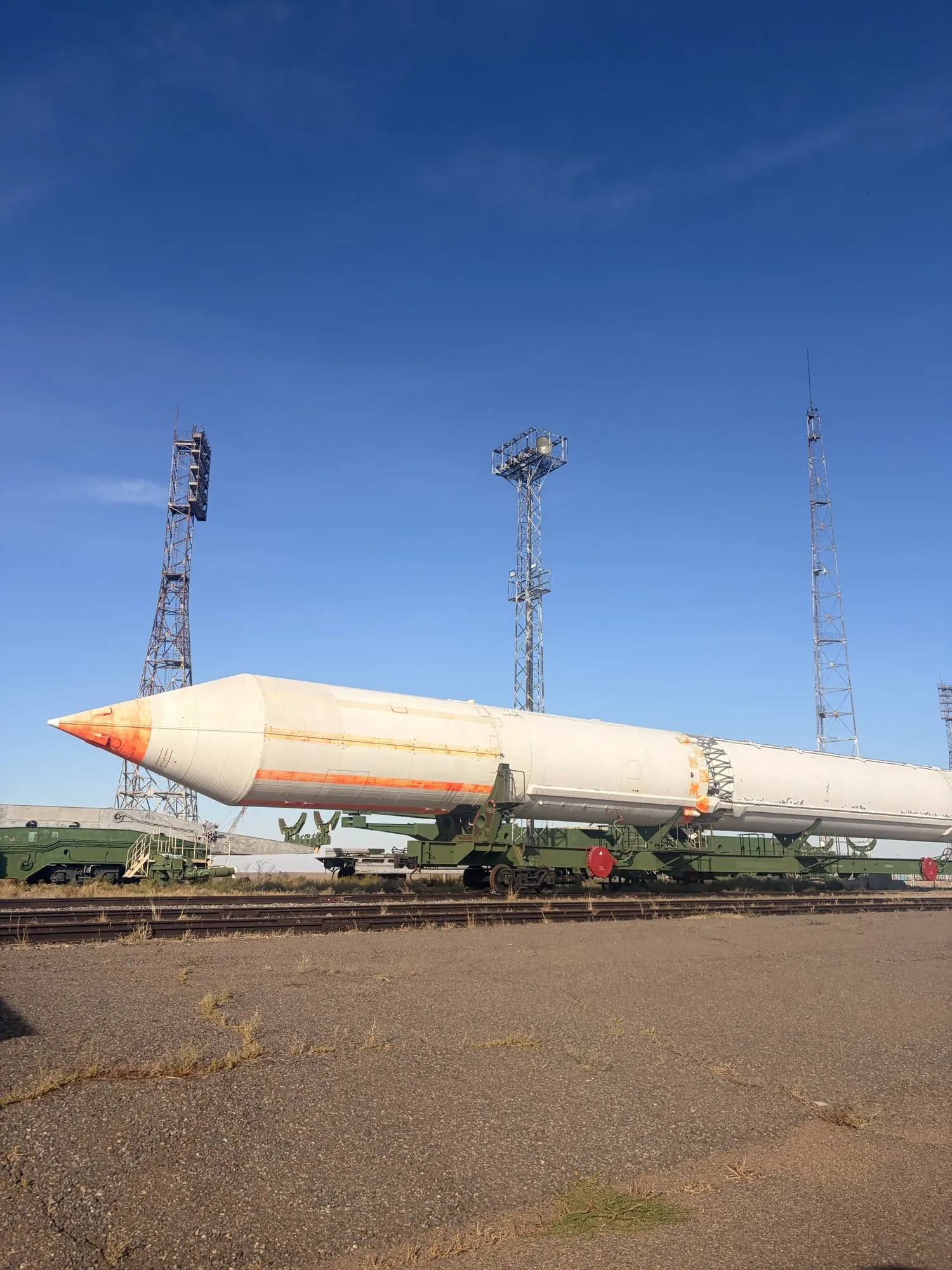
Interestingly, their feud became increasingly technical and perhaps philosophical. Korolev wanted the nuclear missile rockets to be powered by liquid oxygen and kerosene, a safer and higher-performing propellant ideal for space travel. Yangel pushed for storable toxic propellants, which were extremely toxic to life, but enabled missiles to be fuelled and operational faster, optimized for ballistics. Both men were brilliant engineers, and neither were simply incompetent bureaucratic rivals. But Yangel was loyal to the Soviet Union, and Korolev seemed more loyal to space exploration. This is when things reportedly got quite nasty. At a technical meeting, Yangel reportedly attacked Korolev’s entire approach as a dead end for Soviet missile technology. Khrushchev, the Premier of the Soviet Union at that time, obviously grew to prefer Yangel’s more weaponry-favouring approach. Essentially, the two divided Soviet rocketry into two domains: Yangel became central to the nuclear missile program, and Korolev became indispensable to the space program.
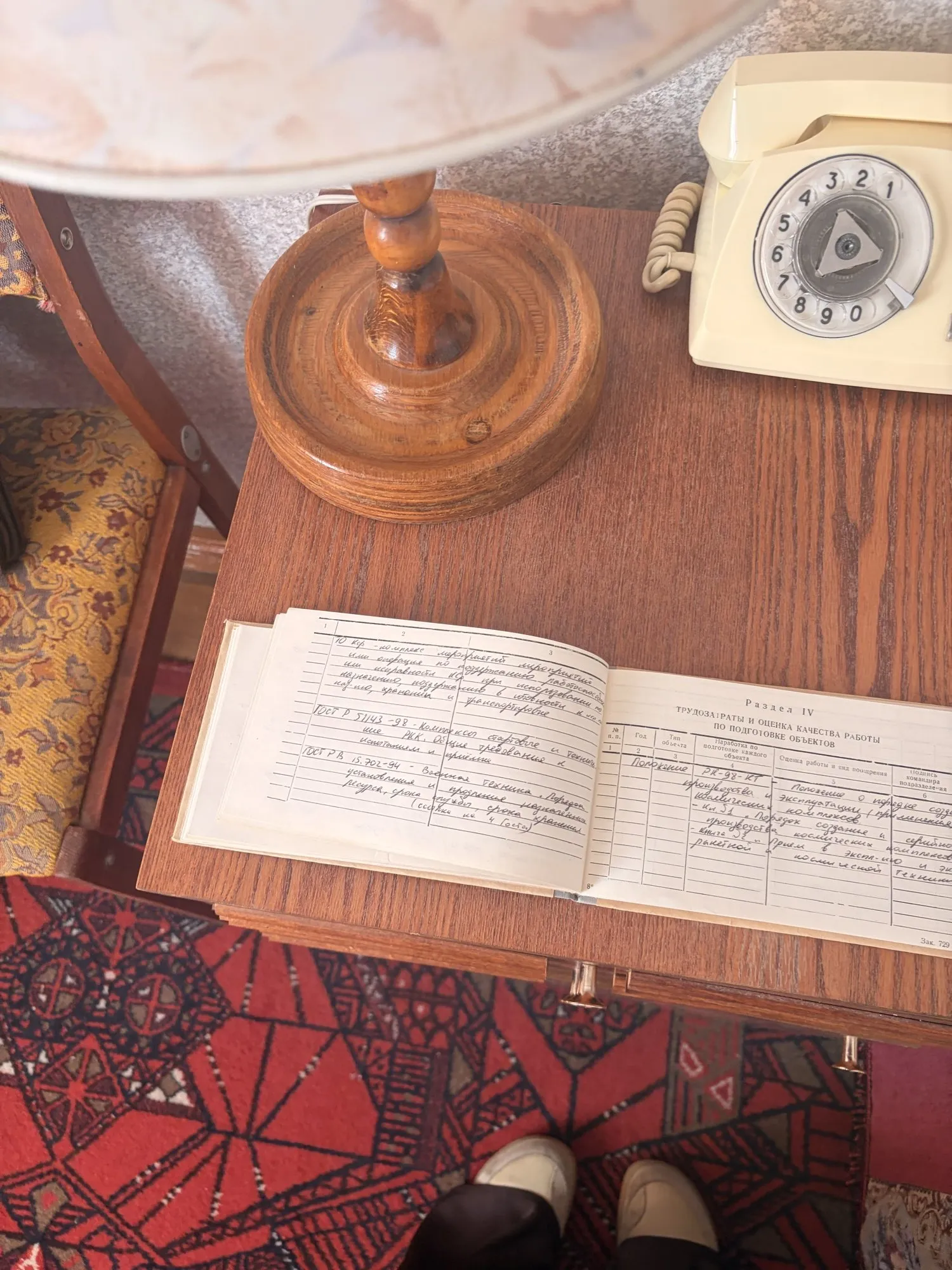
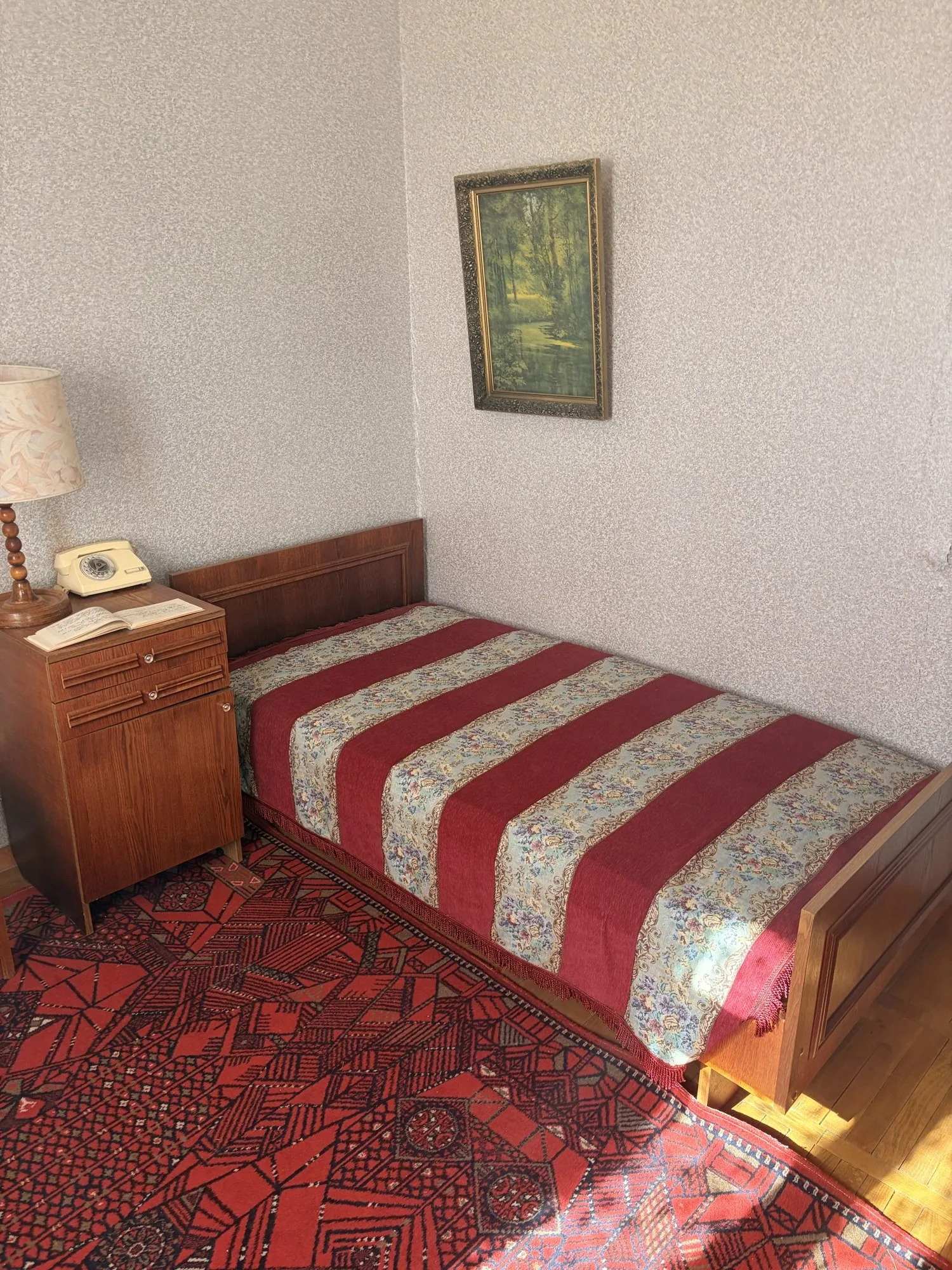
Yangel’s room is preserved in its original state. It was across the hall from where I slept, fully open. I wouldn’t say anyone really cares who enters it, and what you do in there. Interestingly, you also had access to his personal library and certain launch logs. He seemed to love literature.
Site 45
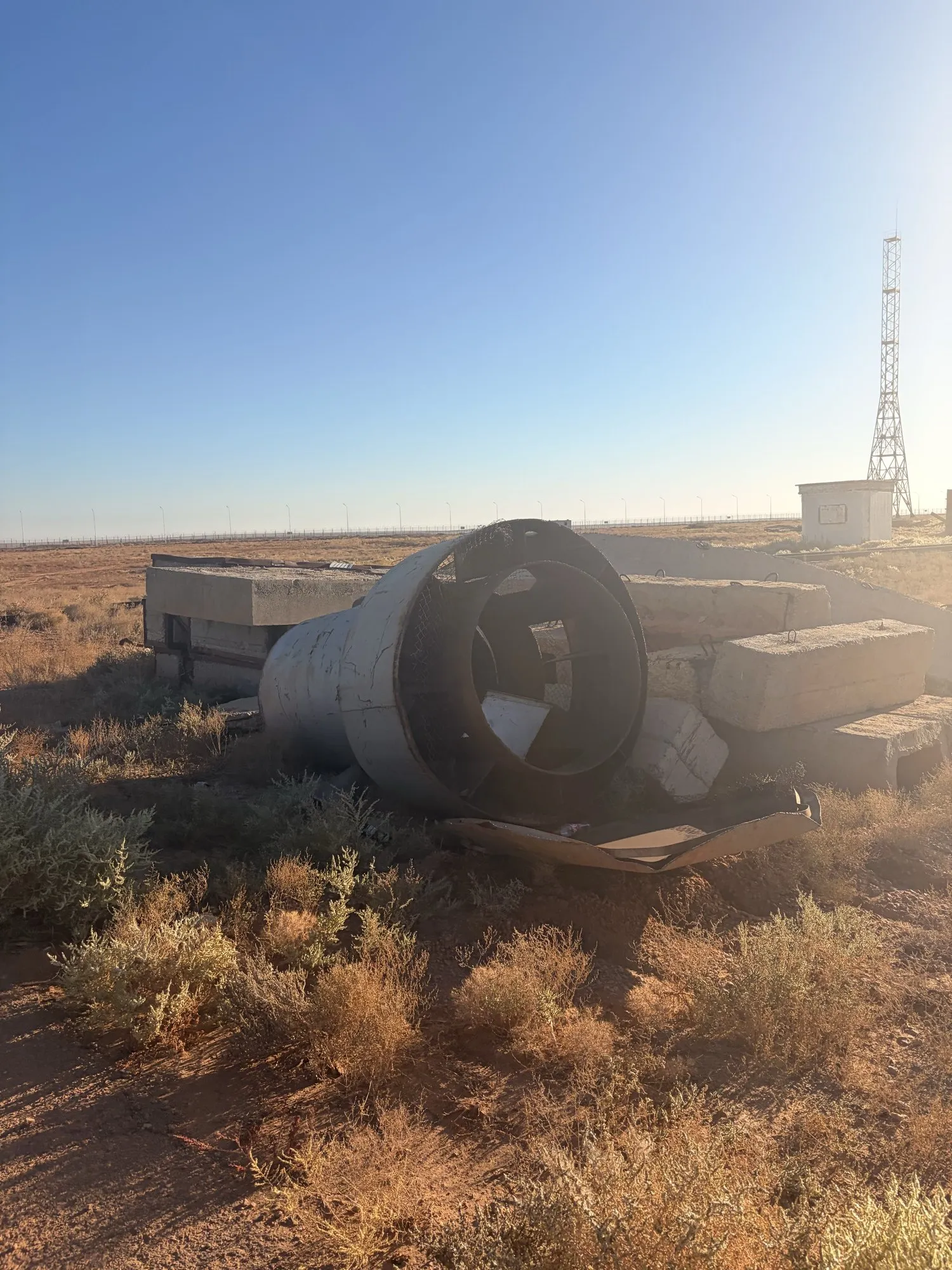
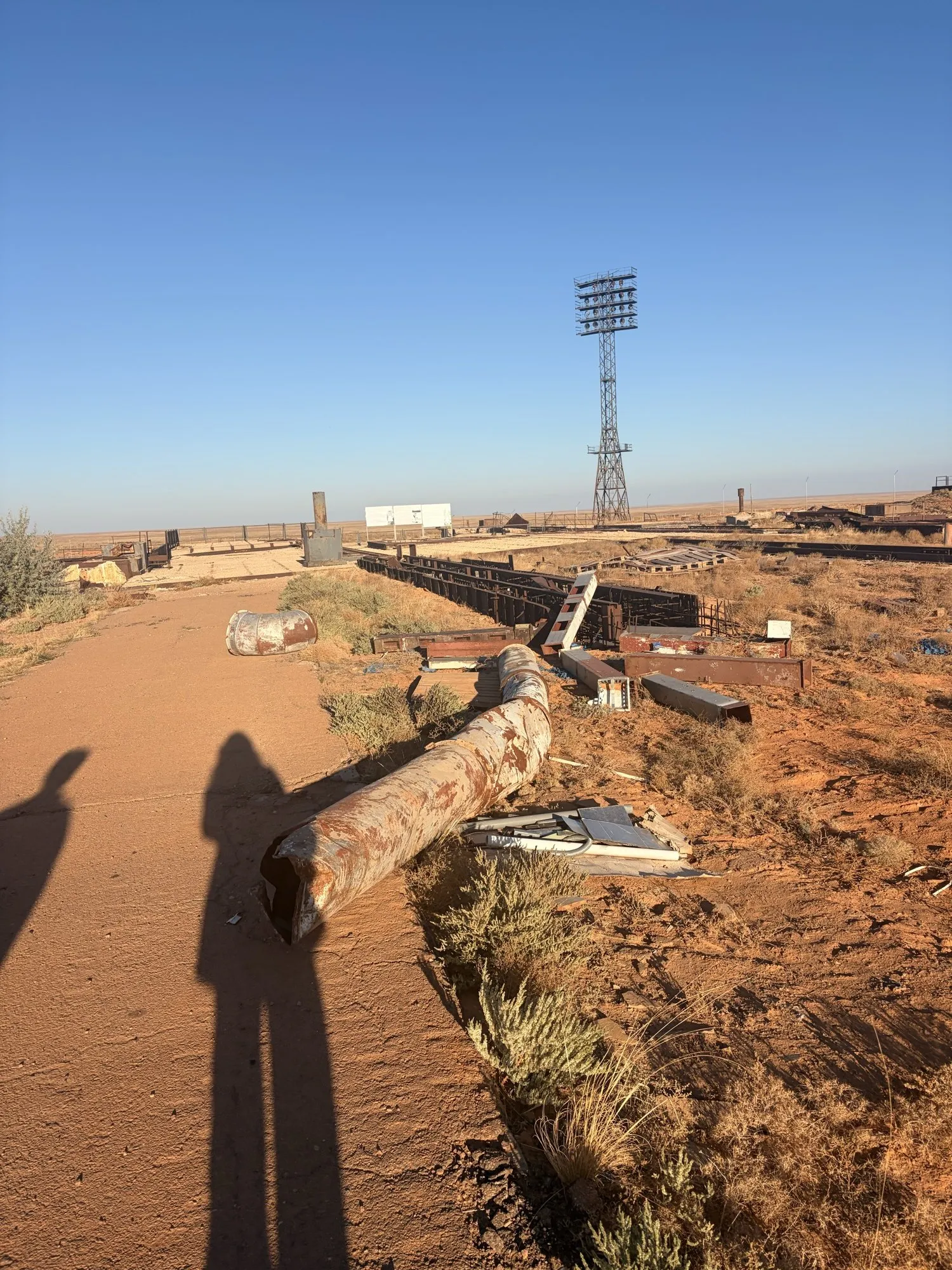
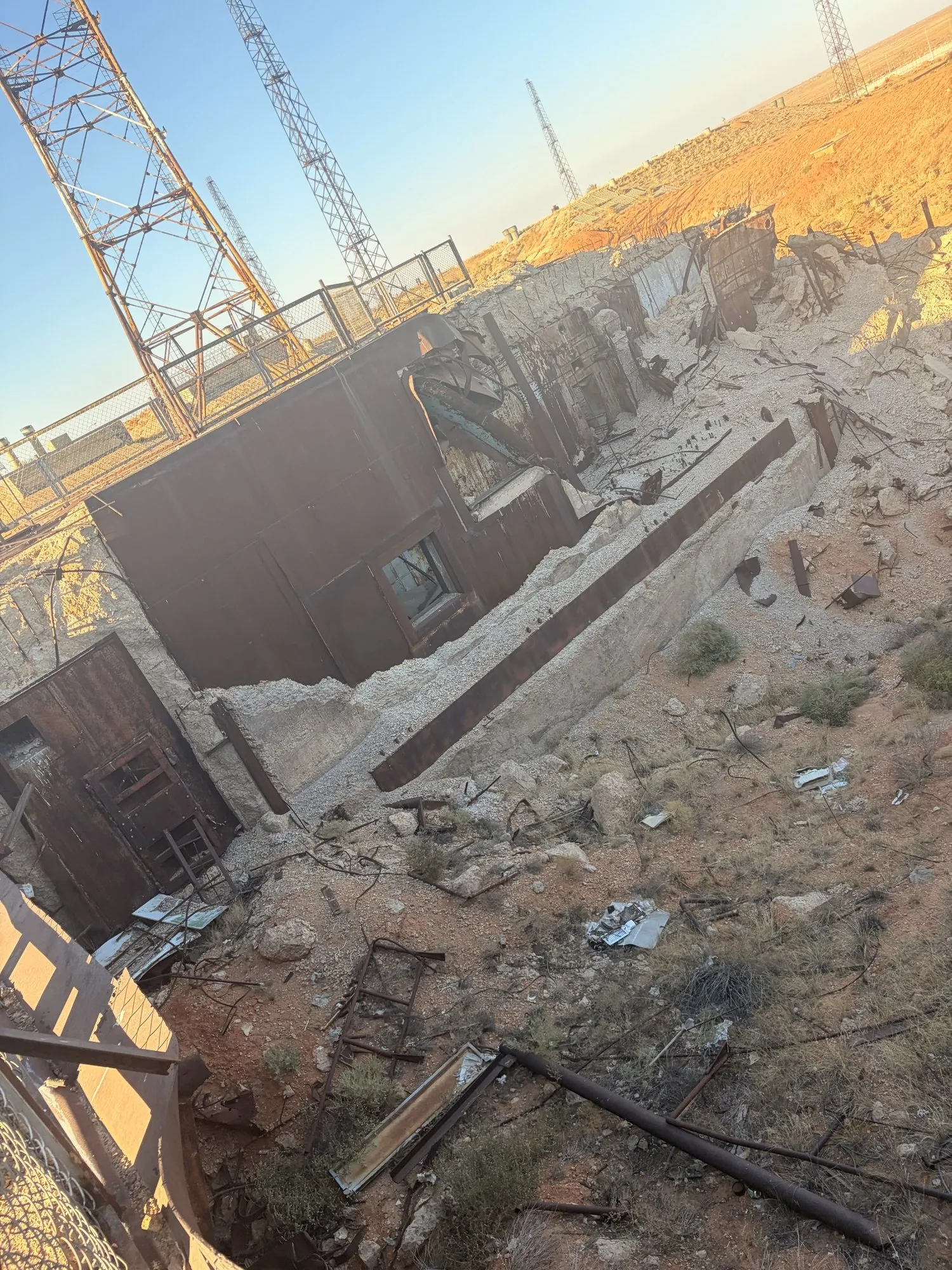
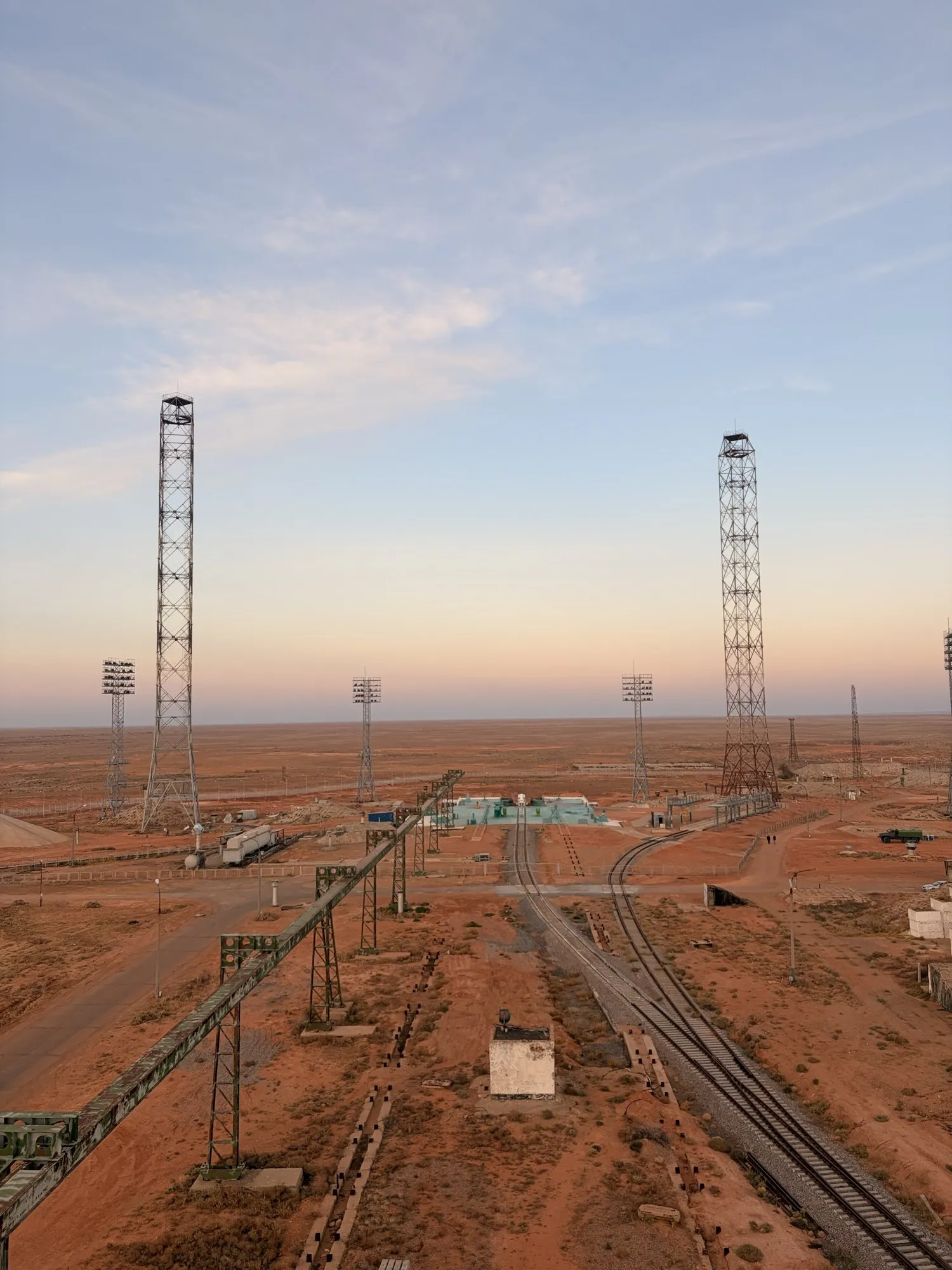
Something that may be unfamiliar about Soviet and post-Soviet culture is that if something ages out, breaks, or explodes, you usually just leave it there. Clean-up efforts take away precious time and resources. Baikonur is larger than the state of Delaware, meaning there’s plenty of room to just shift left slightly, and try again. For example, I got to walk around Site 45/1, the current operational pad where Soyuz-5 made its maiden flight just this April of 2026. If you walk maybe ten metres to the right, you will find yourself at Site 45/2, the neighbouring pad that got obliterated in 1990, when a rocket malfunctioned and crashed back into its launch complex. That pad looks exactly how you would imagine if a rocket exploded there a few decades ago. There are quite a few launch pads in that state at Baikonur.
The Nedelin Catastrophe
Ten minutes by car from my abandoned military town stood the site of Yangel’s greatest tragedy, Site 41. This site was, despite my earlier musings, pristine. And not because it got cleaned up just to honour the dead.
Back in 1960, Yangel was preparing to test his new R-16 intercontinental ballistic missile using his preferred heptyl and nitric-acid-based oxidizer. Both of these substances are toxic, and ignite spontaneously when mixed. Technicians discovered propellant leaks, a serious problem that would appropriately call for drainage of the missile entirely before repair. However, coming up was November 7th, the anniversary of the Bolshevik Revolution, and officials wanted it done before then to demonstrate Soviet military strength. Workers and military officials worked right near the rocket base. As engineers attempted to correct the missile’s electrical control system, the operation unintentionally triggered the command to start the second-stage engine. Essentially, all the energy that was going to get this rocket into space was released onto the ground.
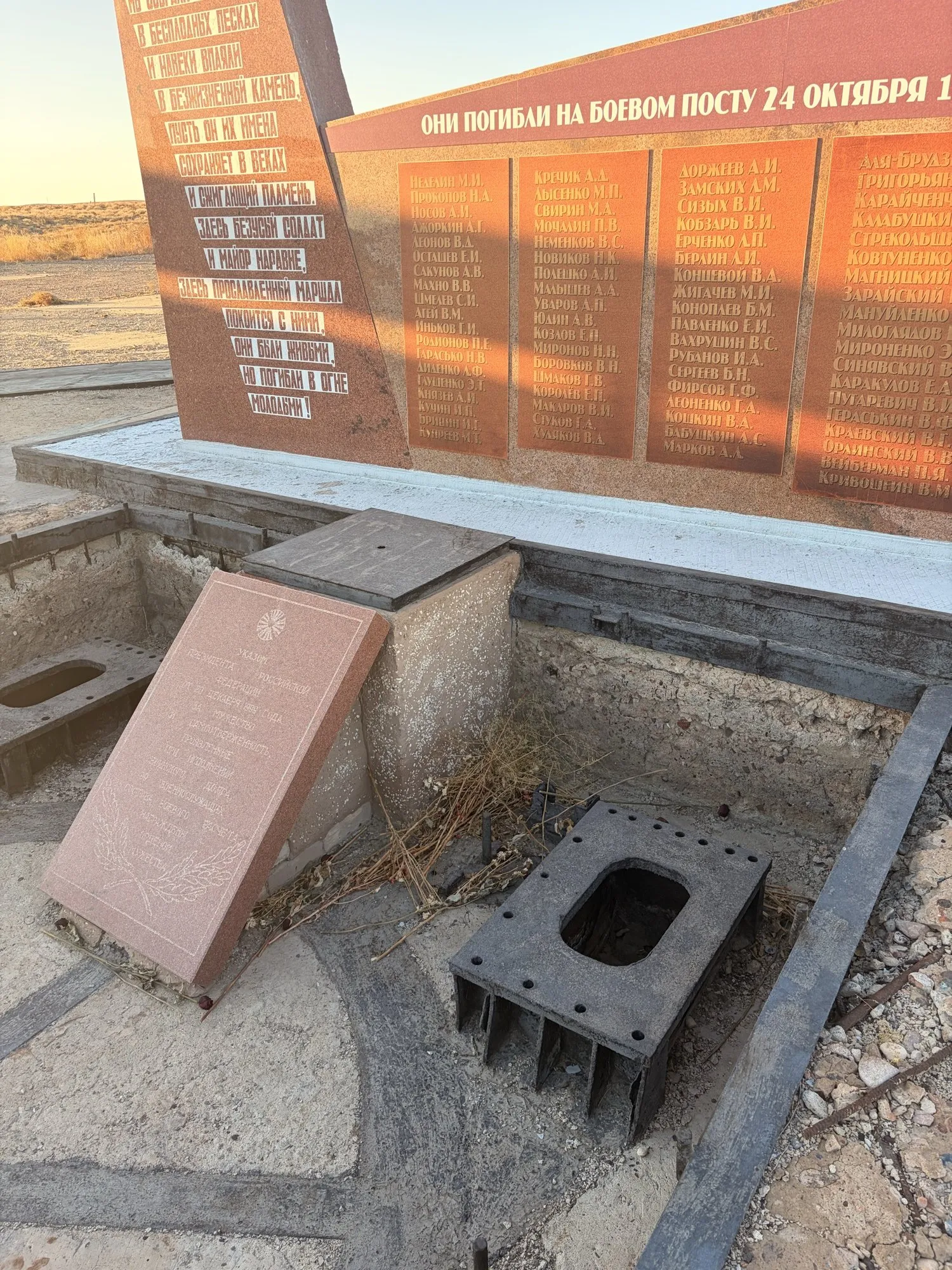
It was horrendous beyond words. Death estimates vary from 100 to 126 or more, including some of the Soviet Union’s most experienced rocket specialists. 150 meters from the pad was the designated smoking area. Yangel had survived because he stepped out for a smoke just minutes before the explosion. It’s hard to know which accounts of Yangel are true. Some say he heroically helped the burned until he was forcefully restrained. Some think it’s heroic propaganda. Ultimately, almost every person would find it very hard to forgive themselves for such a tragedy, regardless of how much blame can be cast. Premiers pressuring officials, officials pressuring engineers, leading to rushed catastrophes and deaths were common for that time.
The Soviets repaired this site within months as Khrushchev was determined to get back on schedule. It was a rare occurrence, as they decided repairing the site was more practical than building a new complex (explaining its comparatively good condition today). This was the height of the Cold War. The tragedy was classified, and the deaths were swept under the soil without much thought. That is until 1989 during Gorbachev’s glasnost policy, and 1998 when the memorial was inaugurated.
The atmosphere at this site today is solemn. Empty fields stretch in every direction, and a red memorial stands near the launch pit stating (translated to English):
We gathered their souls
In the barren sands
And sealed them forever
Into lifeless stone.
May it preserve their names
Throughout the ages…
Here an unbearded soldier
And a major are equal.
Here a celebrated marshal
Rests alongside them.
They were alive, But perished in flames, Still young.
Right before my visit to this site, I was taken to the still-active rocket Assembly and Testing Building, sat in some sort of conference room, and was shown horrific videos of people burning in the flames. It turned out to be real preserved footage from that day, colourized and all. It’s difficult to capture the feeling you get looking at this piece of stone, near a rocket hole, in the middle of nowhere, after getting fed videos of people burning to death. I hope whatever comes after death was kind to these souls.
First Night
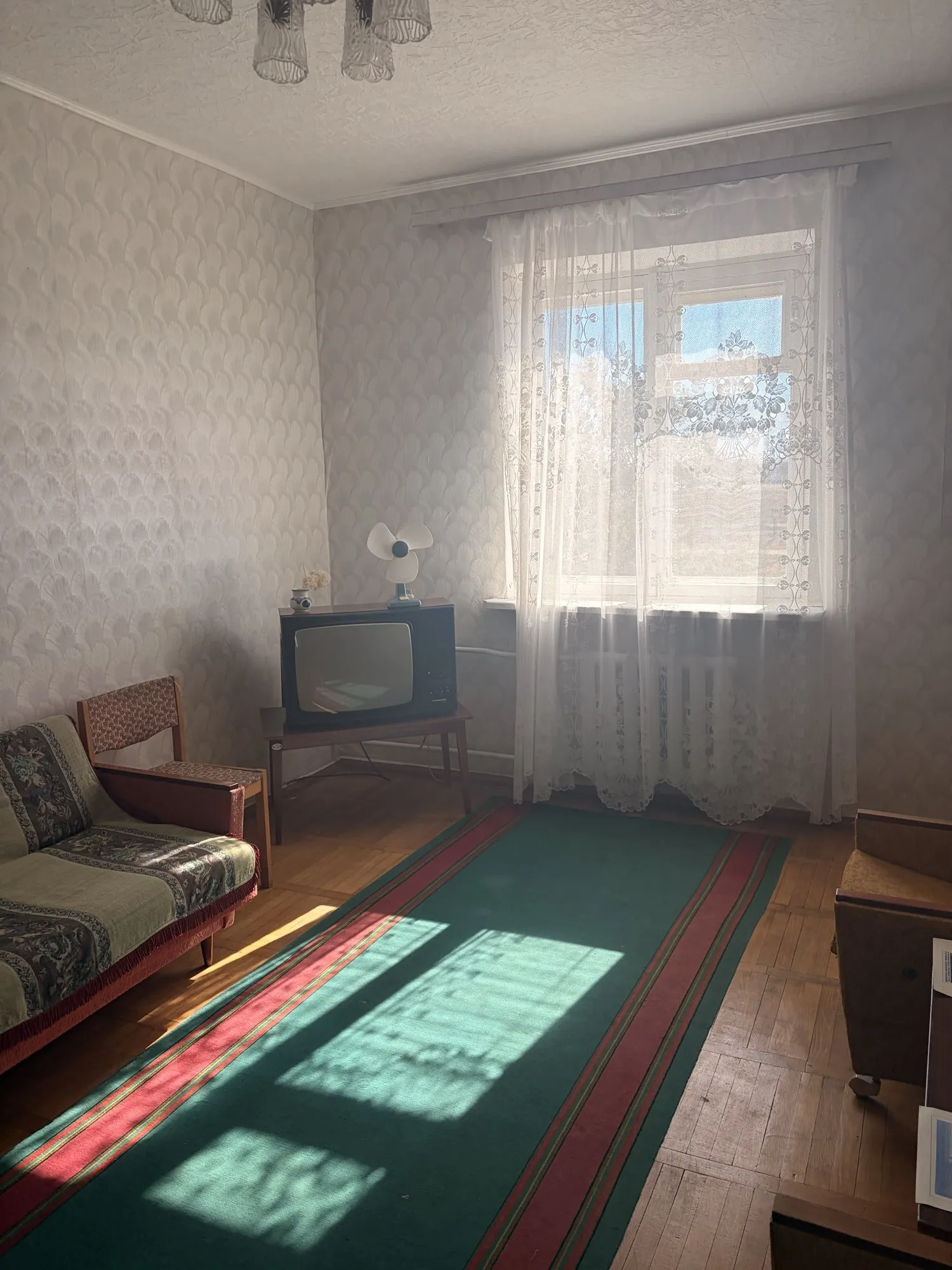
My dormitory felt like being transported back in time. Oleg was an older man, who works at the Assembling Building, and does tourist tours part time for extra cash. He seems ethnically Russian, but when I asked where he’s from, he responded with: “the Soviet Union”. He explained he was sent to serve there as military personnel before the collapse. Baikonur’s isolation means it functions a bit as a time capsule, a small area where the Soviet Union never really culturally ended. So he stayed, never really felt the want to venture into the outside world, and continues living there with his family inside the cosmodrome. He was a kind man, but indeed like he said, very Soviet. His wife and daughter would feed us porridge and soup in the old-school cafeteria. We made trips to the water jugs to fill up our toilets (though most bathrooms in the cosmodrome were outhouses), and boiled water to wash our faces. Water outages are common; there was no running water during my stay. While working for NASA and SpaceX carries a sort of prestige in the US, Baikonur workers still live very hard lives. Just as they did back then.
In the evenings and mornings, I’d walk around the abandoned town, as deep as I would brave. The weather reminded me of Mercury. Scorching once the sun was up, freezing once it set. There was something peaceful about it. Walking around in such a desolate, historically bizarre place. Though I did have some anxiety about contamination. In 2013, a Proton-M rocket crashed during take-off, releasing hundreds of tonnes of highly toxic propellants (the same ones Yangel favoured in his designs).
Aya is a very young woman who grew up in Baikonur City. Her mother had worked on the railways interconnecting the cosmodrome. She remembers being a child during the 2013 environmental accident, and recalls a mushroom cloud in the air. Officials herded people into their homes, barring anyone from stepping outside for days. Had the winds brought the cloud onto the town, many would have suffered immensely. Luckily, the rare occurrence of rain mostly dispersed the cloud. Still, much of the soil and water had been contaminated. Generally, there were legitimate concerns for the long-term health consequences for people who lived around Baikonur. Oleg scoffed at her story, stating all of this was caused by overly cautious safety precautions, claiming no one was ever actually in harm’s way. The two got heated.
I think both Aya and Oleg are wonderful people, who grew up in circumstances few understand. I also kept remembering Oleg’s own words that he was a Soviet man. And I know the Soviets trained you into a code of cognitive dissonance and denialism.
Therefore, I wrapped my pants into a plastic bag, wiped my legs with a wet cloth, and called it a night.
Day Two
The day started early and with porridge. We drove to Baikonur City, a closed city with a separate checkpoint for entry. This was a true, preserved Soviet town, minus the addition of cars, and some store logos. We walked around the central square under the giant Lenin statue, and gazed at technology for weapons of mass destruction around town. Some casual pieces include:
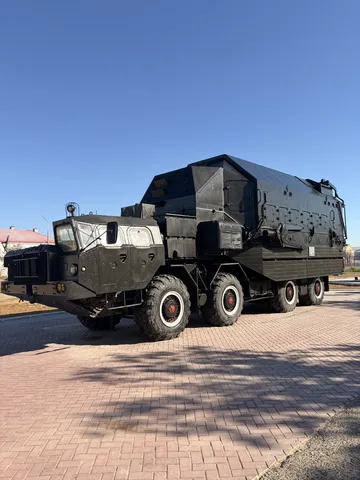
The MAZ-543M eight-wheel military vehicle, designed to transport the missile's nose section, and install it into a missile.
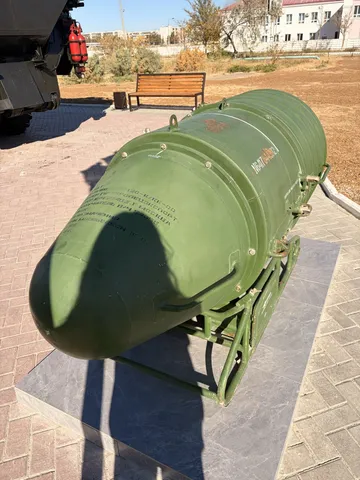
A storage and transportation container for an intercontinental ballistic missile.
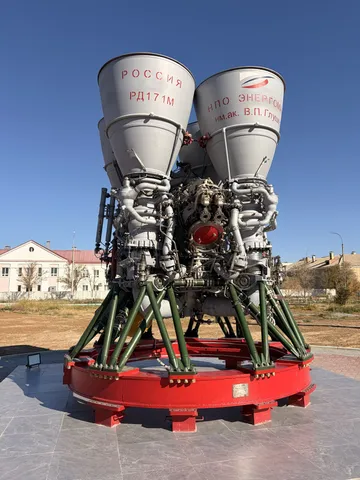
The engine from the RD-171 family, one of the most powerful single-liquid propellant rocket engines developed.
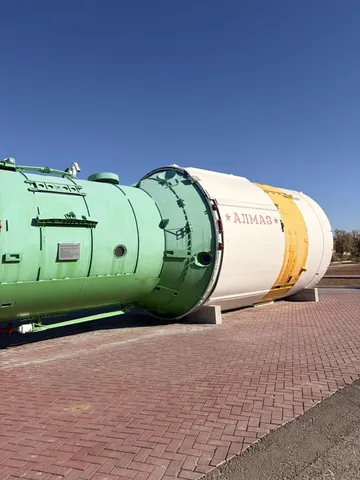
A spacecraft from the secret military space station program, originally developed to conduct military reconnaissance from orbit. One station even carried a cannon.
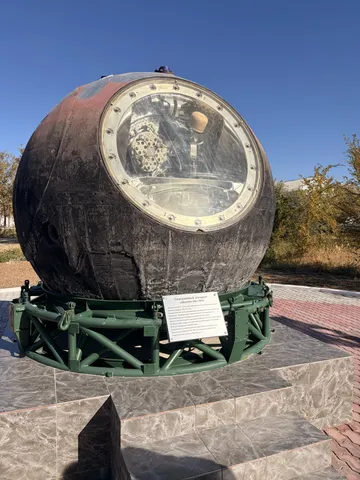
A scorched capsule that re-entered Earth in 2014. It carried five geckos to study reproductive behaviour in microgravity.
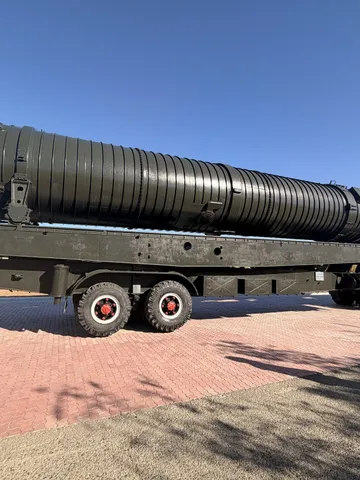
And another intercontinental ballistic missile container.
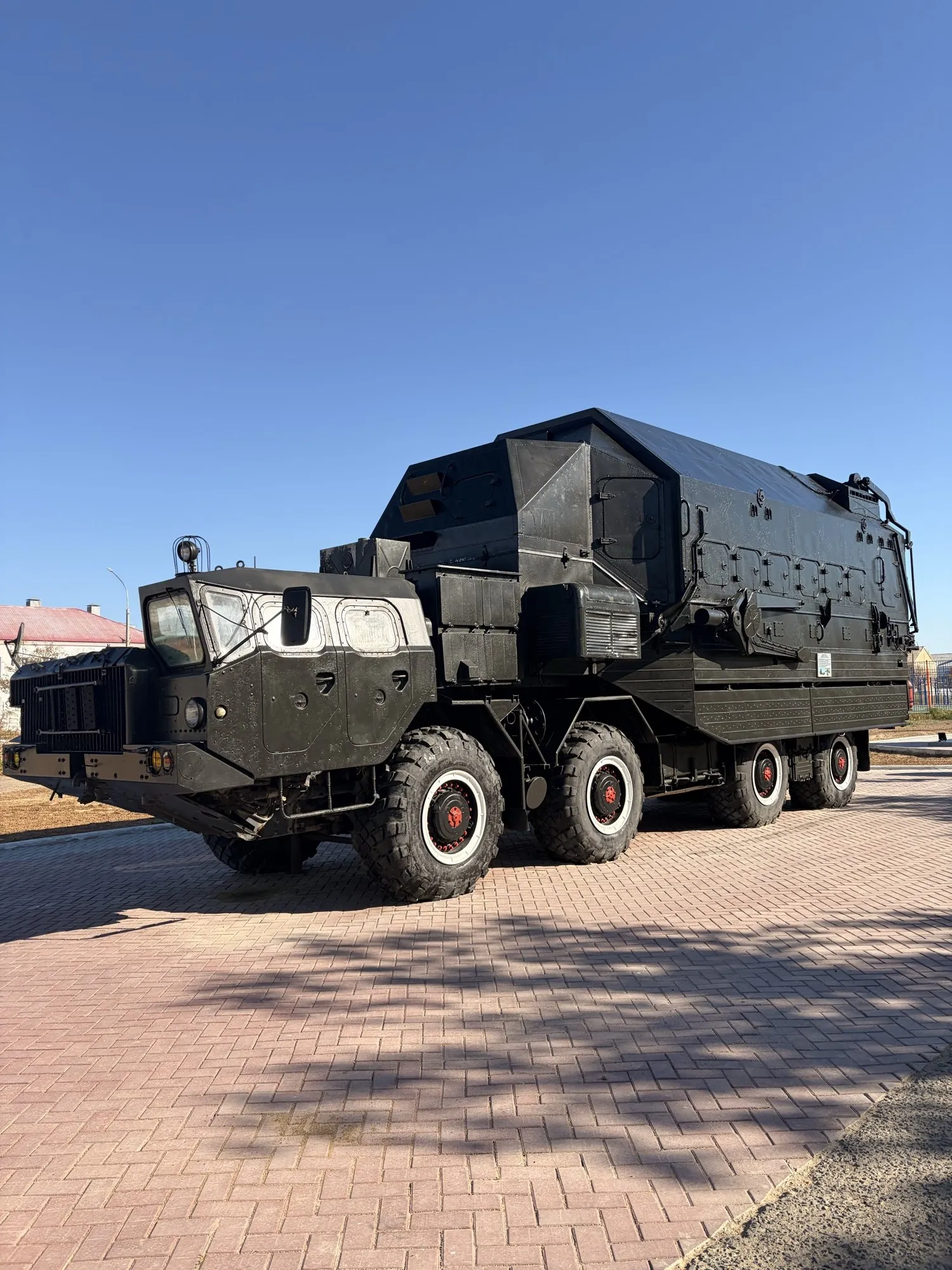
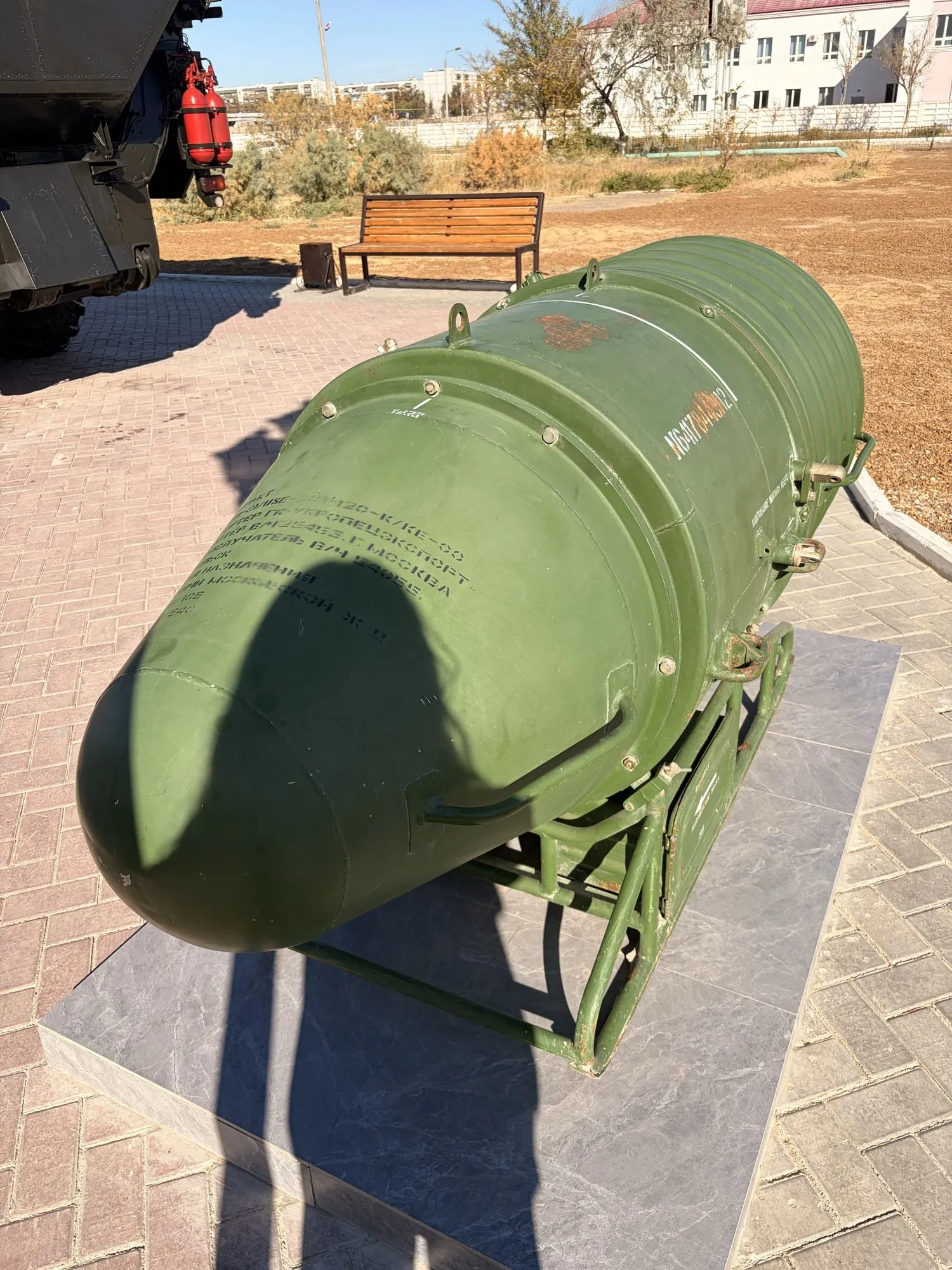
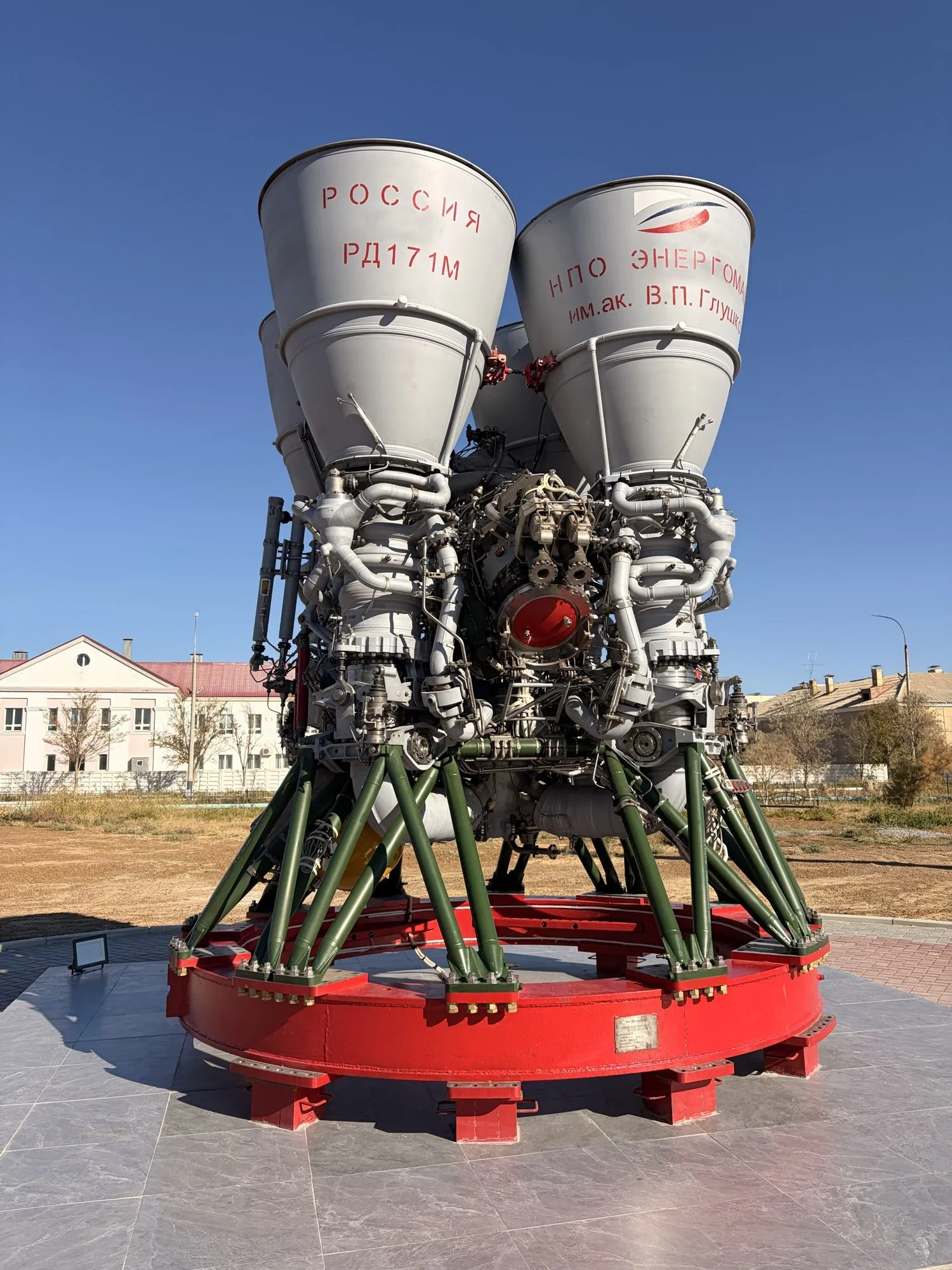
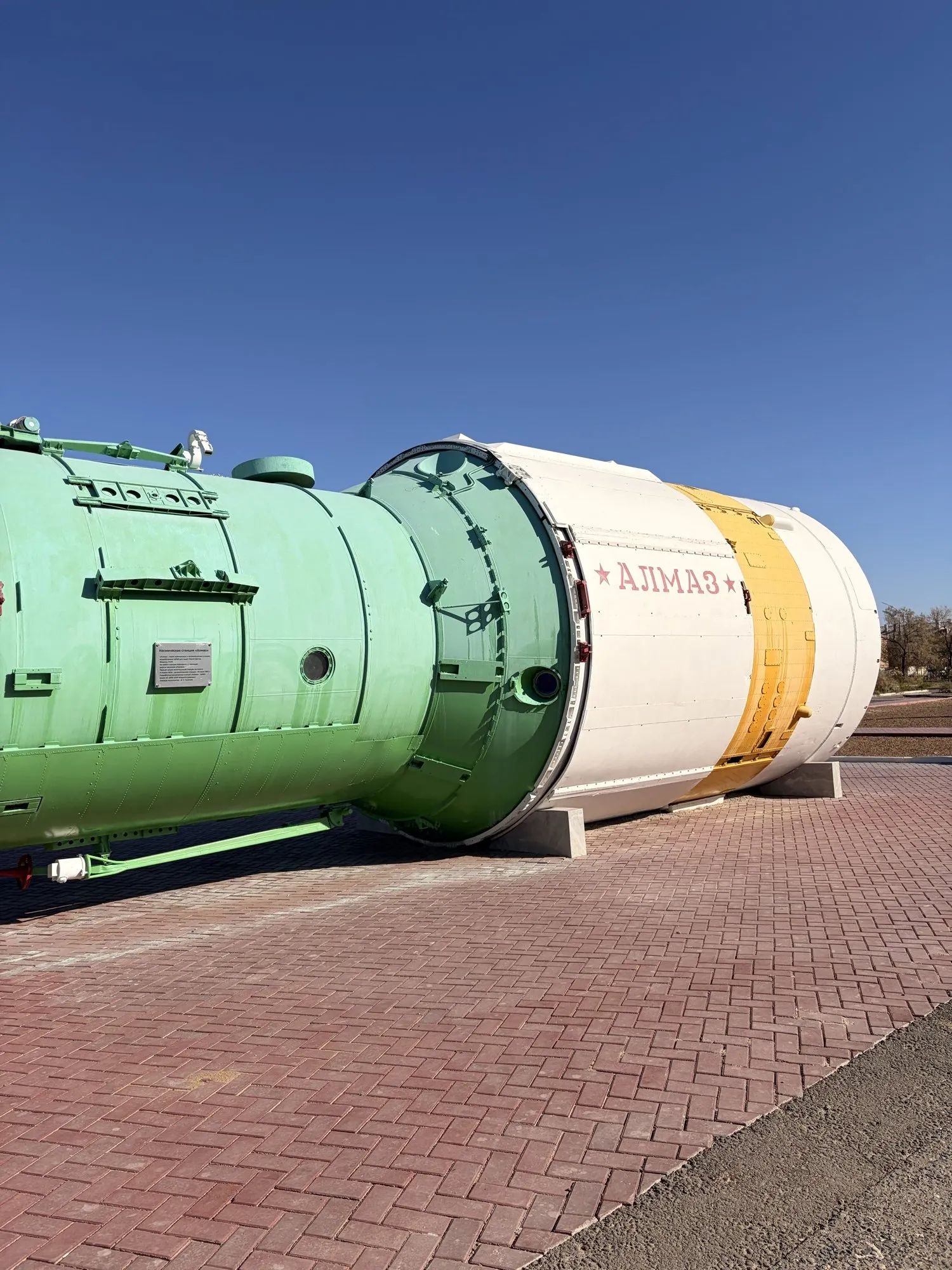
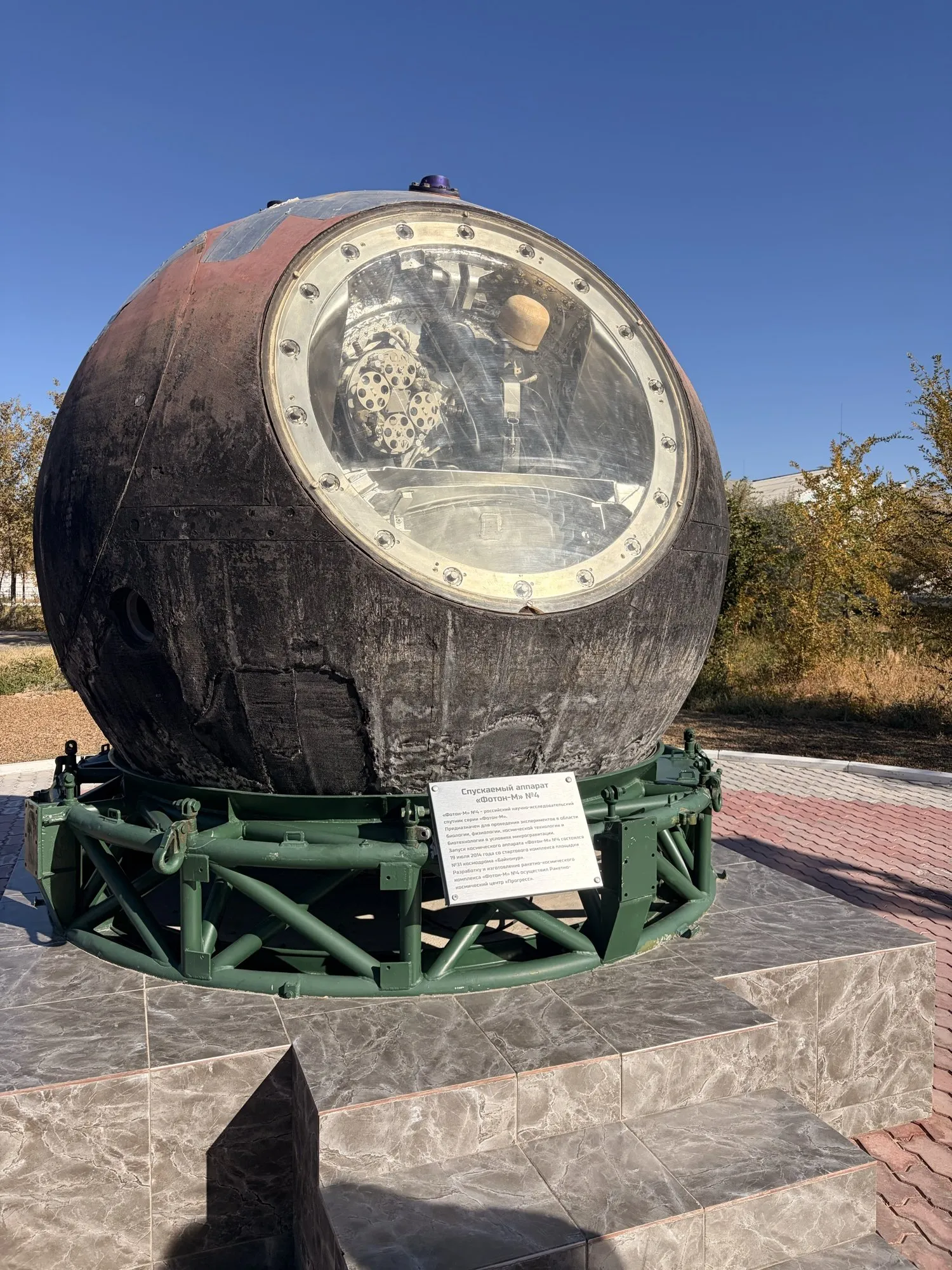
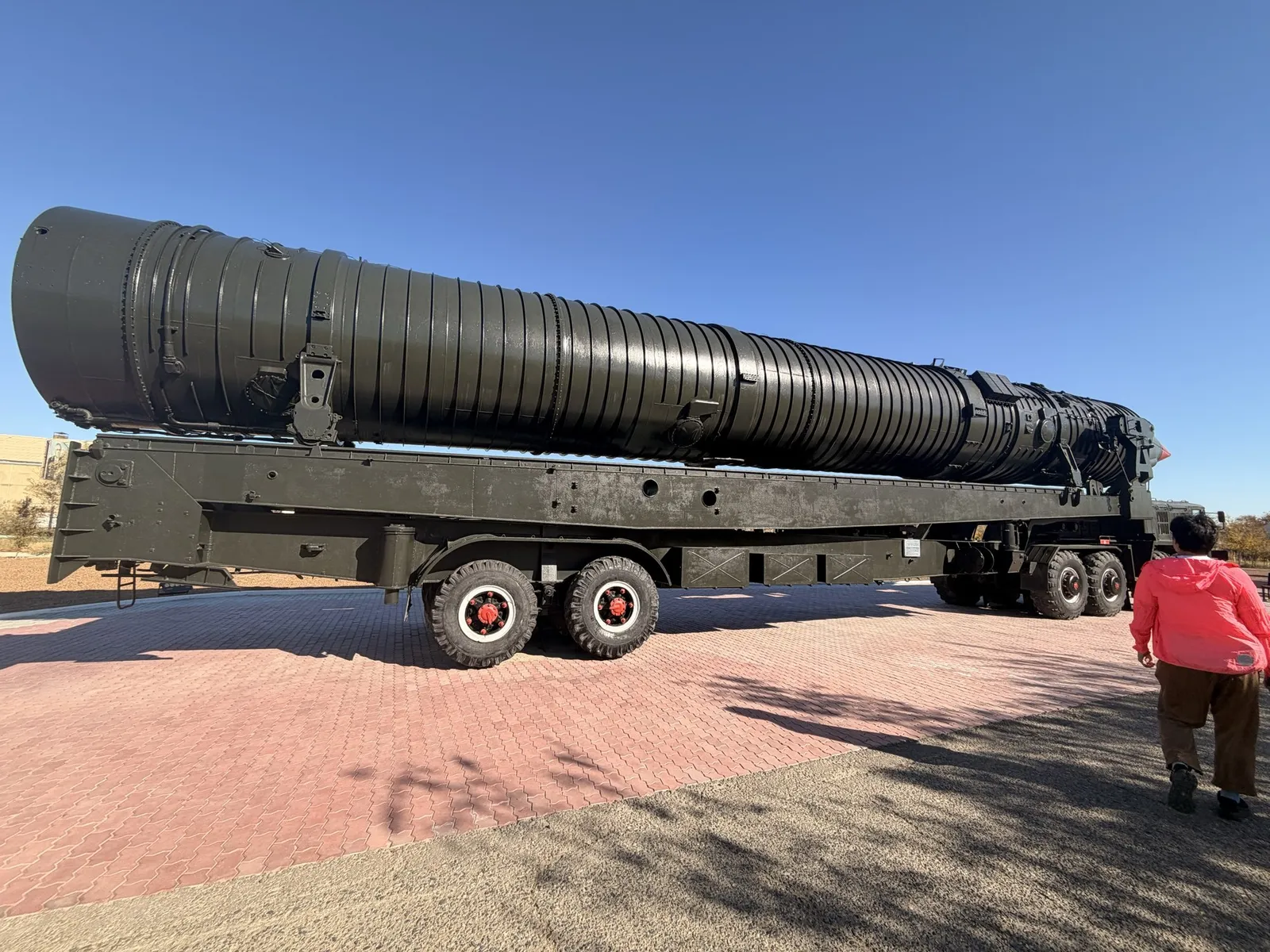
Here is the part where my short-sightedness really sunk in. I had come, I thought, fairly prepared into this experience. I’m familiar with Kazakhstan and post-Soviet culture. I’ve always loved aerospace. I wanted to stand where it all started, and I understood I’d see a lot of remnants of the Cold War, not just the space race. But I overlooked something obvious. This place was built initially to test rockets for weapons of mass destruction, not for the love of space exploration. And the current Ukrainian–Russian conflict would only motivate the Russians to preserve this place in an even stronger “look at all this military prowess” light. Many of the casual military pieces I mentioned had only been donated within the last few years. And even then, Baikonur’s main inception was to test missile rockets. It had only become the birthplace of space exploration due to a series of inadvertent global events.
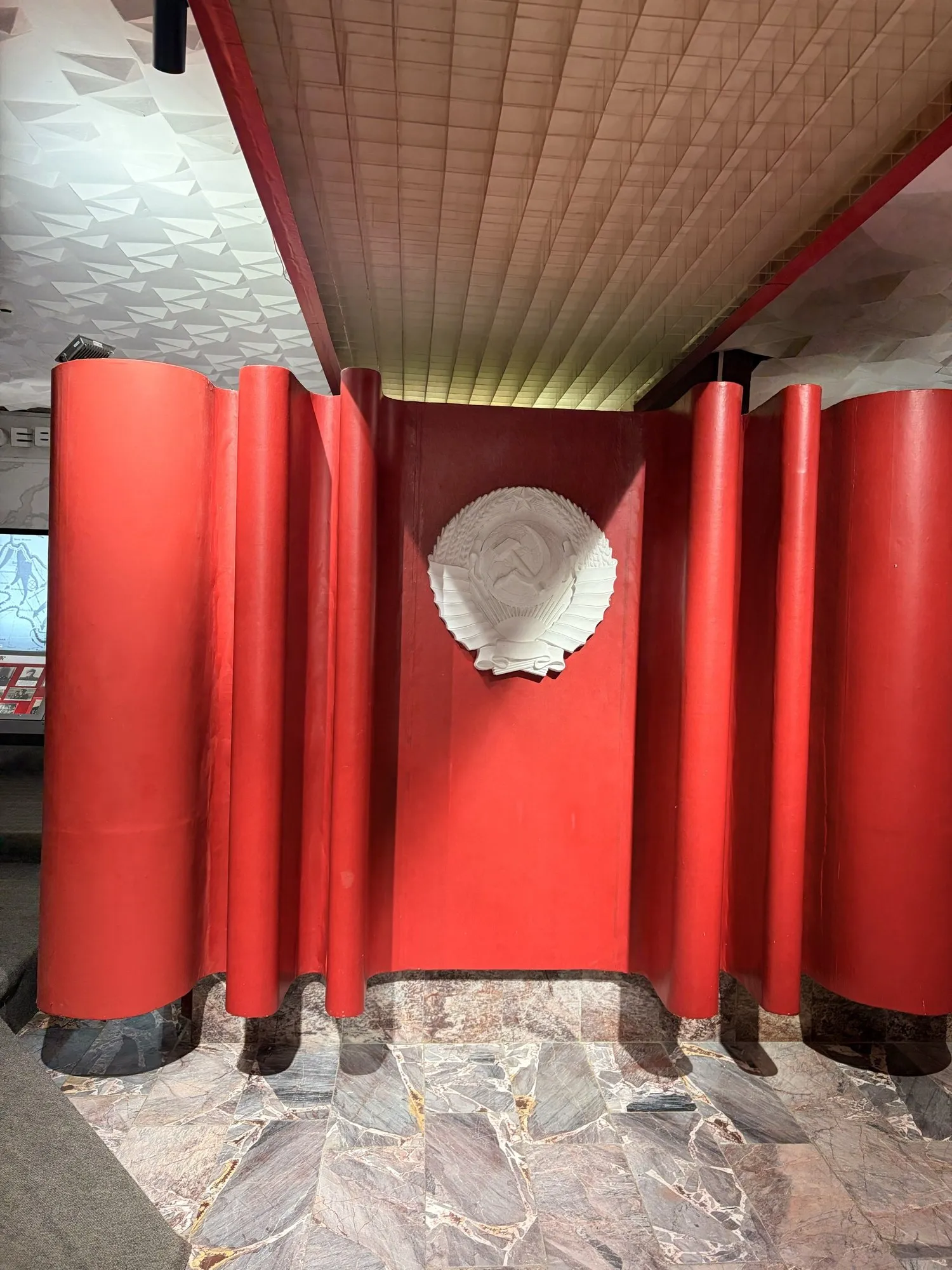
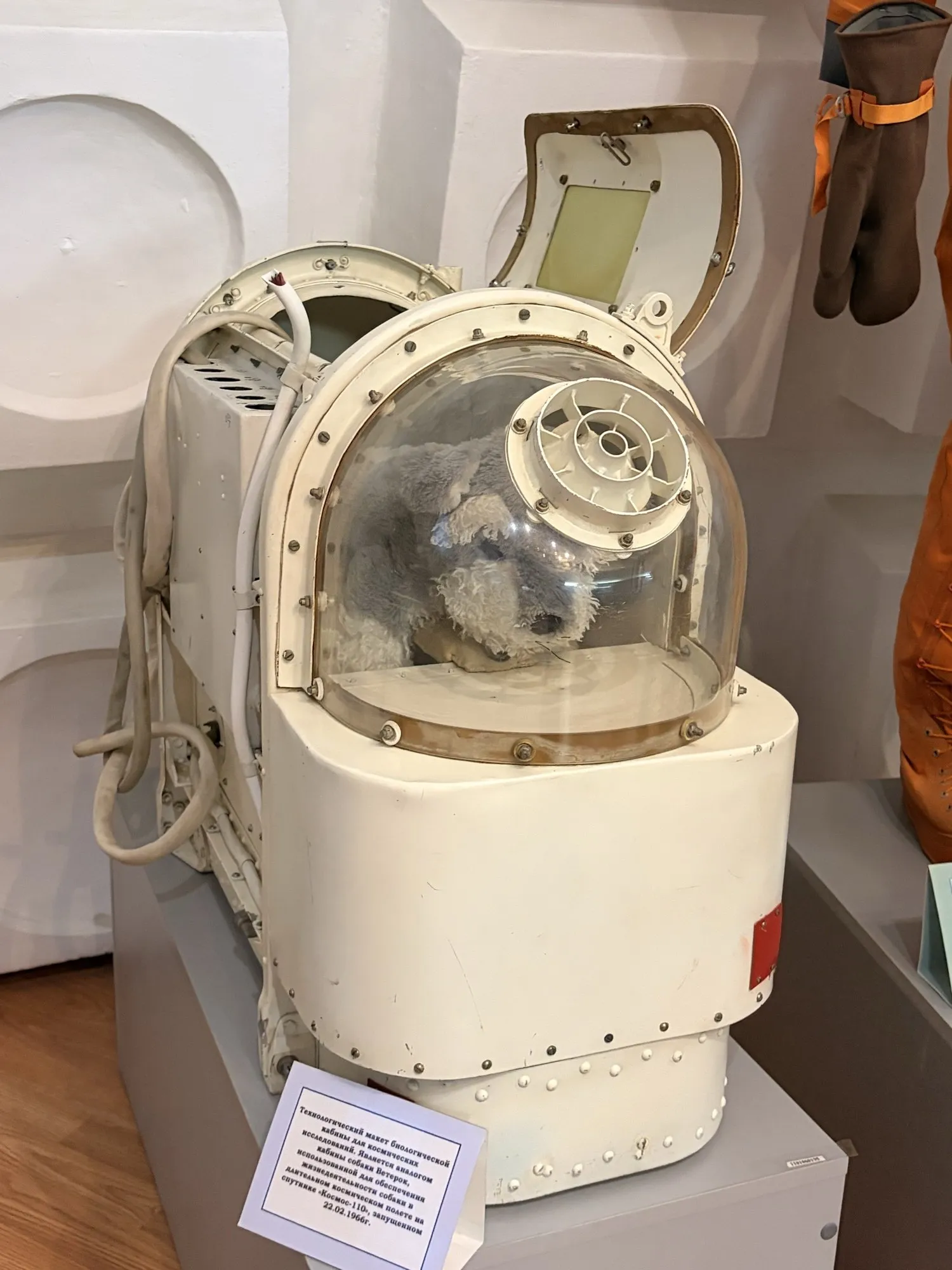
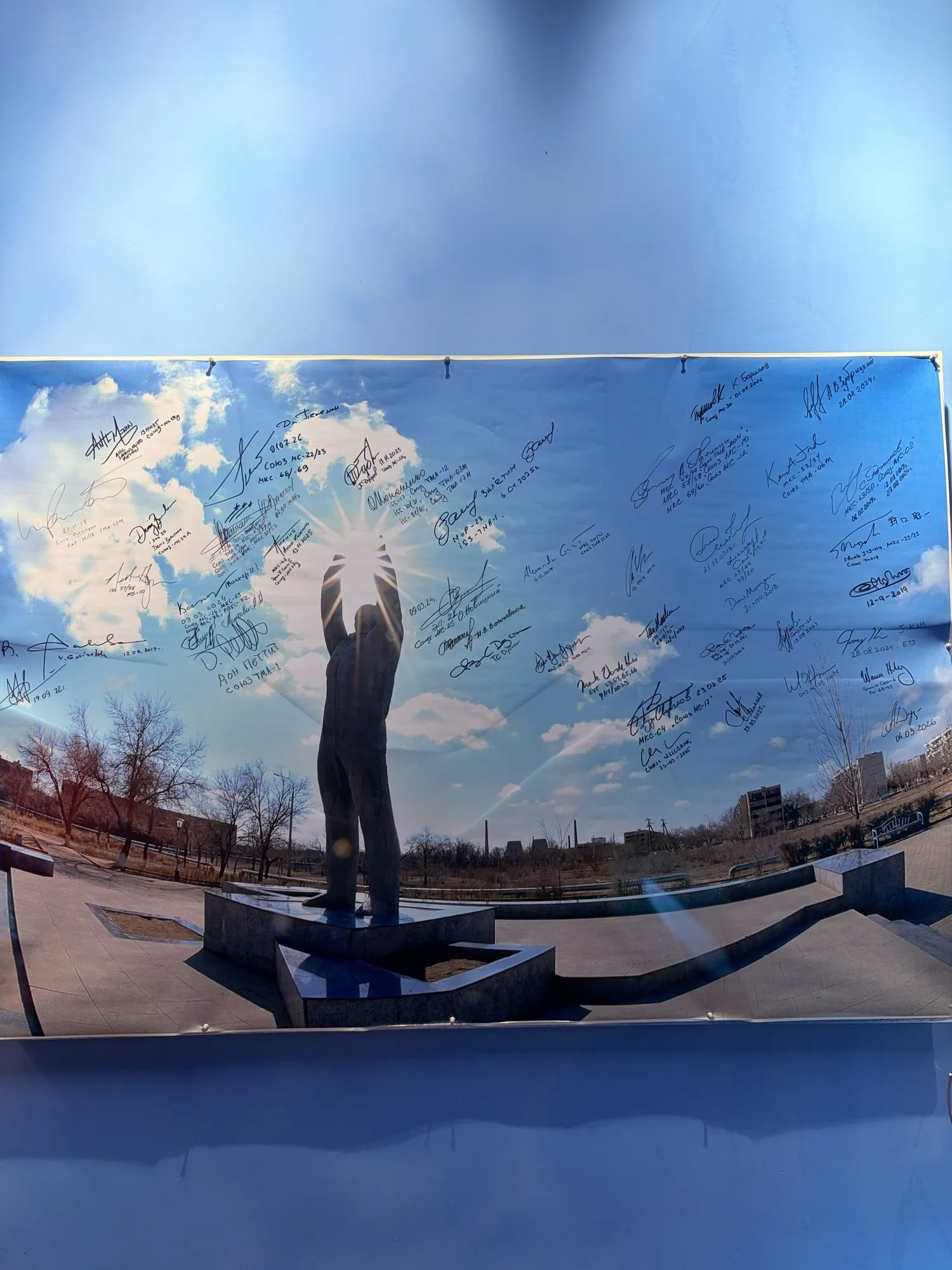
Next, we went to the Baikonur City Museum. The voice of our auntie museum guide would send any person who’d experienced Russian schooling into a mild dissociative episode. Apparently, this tour is traditionally given to every astronaut launching from Baikonur. From 2011 to 2020, NASA had no operational American spacecraft capable of carrying astronauts to orbit, fully relying on Russian Soyuz launches from Baikonur. Which means for almost a decade, Americans had to travel to Baikonur, listen to the auntie talk about Soviet prowess, and then get launched to the ISS near a graveyard of destroyed launching pads. And Americans still launch from Baikonur today! Anil Menon, for example, launched aboard the Soyuz just this July 14th, 2026.
I have noticed that us post-Soviet people are very superstitious. Maybe it’s generational anxiety, or a remnant of attempts at control. The Baikonur astronauts have a long legacy of superstitious traditions. As Yuri Gagarin was driven across the Kazakh steppe to his awaiting rocket, he asked the driver to stop, got out, and urinated on the rear tire of the bus. Upon his survival, this became a good-luck tradition. Women reportedly brought small containers of urine to pour onto the tire. Canadian astronaut Chris Hadfield recounted the spacesuit technicians helped the crew undo their suits to participate. Other traditions include: planting a tree at Baikonur, not watching your rocket roll out (similar to how you wouldn’t see your bride in her wedding dress), and many more depending on how much this quells your nerves. And of course, the group museum lecture from the auntie.
After the auntie went over the entire biased history of the Soviet Union (in this museum supposedly about Baikonur), including its valiant fight against fascism, we re-entered the cosmodrome. We had lunch in the semi-abandoned, military-style cafeteria where they feed the workers. As we were entering, an older cook carried out a cat in one hand, and a half-eaten mouse in the other hand. I noticed that everyone actually running Baikonur is at least middle-aged. They were trained before the collapse, then like cogs in a machine, continued completing their role, keeping this machine going. I have a hunch Baikonur will close not when the infrastructure “ages out”, but when their main work force officially reaches retirement age.
Gagarin Start
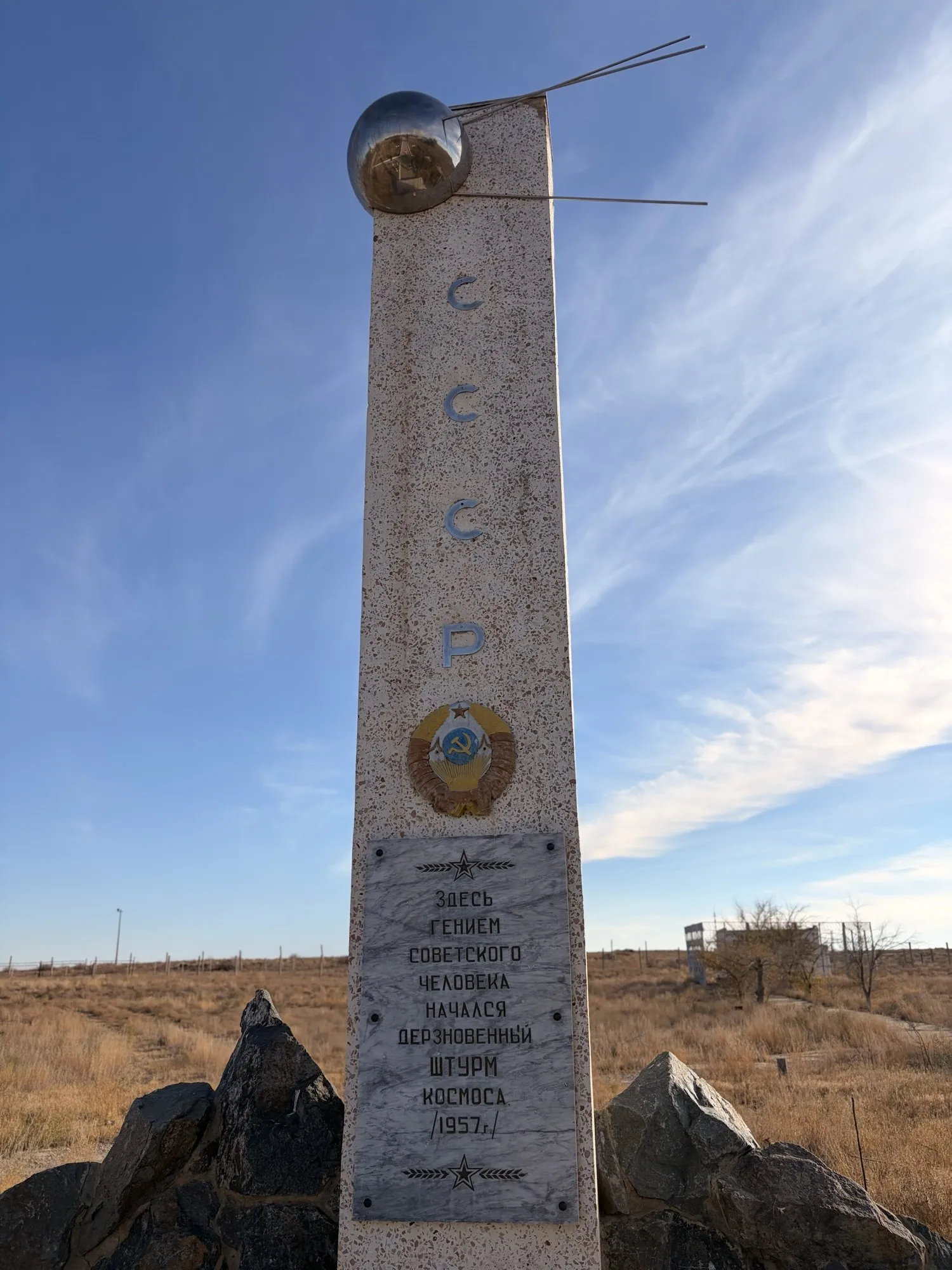
Next came my main motivator for this trip. Gagarin Start, the place humanity first touched space. Its firsts include but are not limited to:
- first man and woman in space
- first artificial satellite to orbit Earth
- first animal to orbit space (rest in peace Laika)
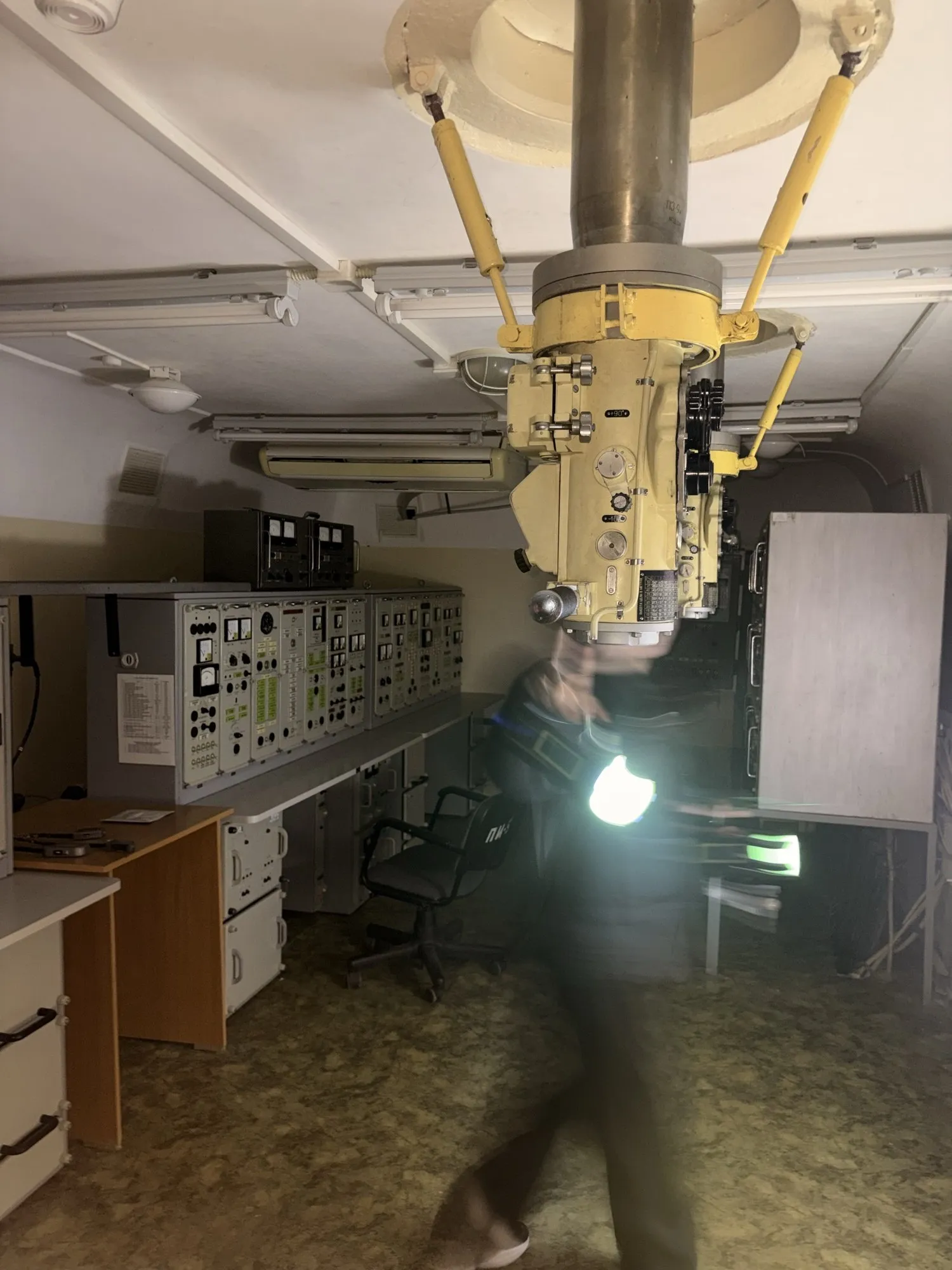
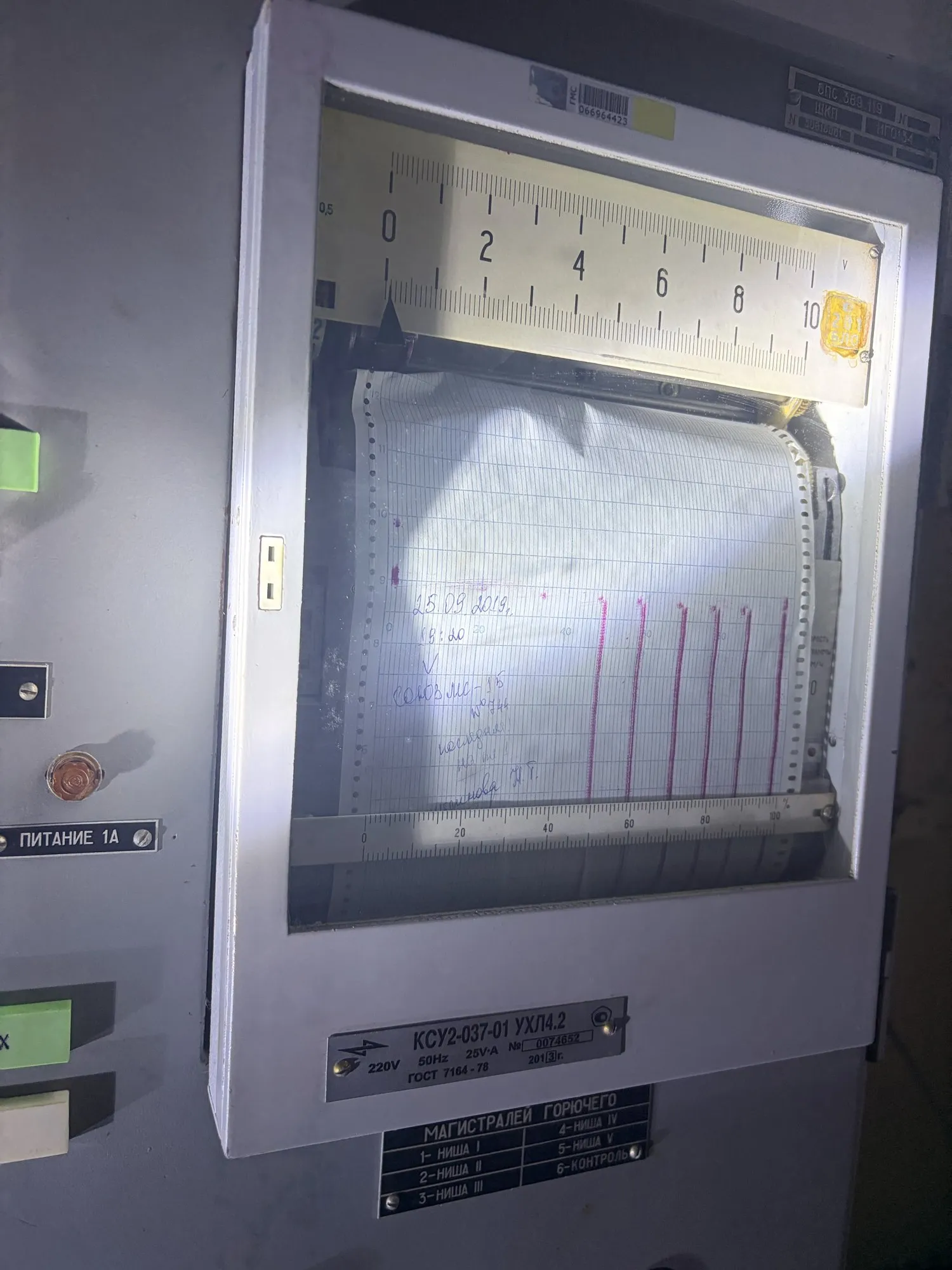
The launch site retired in 2019, therefore we were able to freely explore and go underground into its command centre. To be honest, it was hard for me to comprehend that this dinosaur equipment actually launched things into space just seven years ago. But what do I know, I’m not an engineer. Underneath the launch pad (the hole the rocket goes in before launch) is a gigantic flame trench. It looks like a wide tunnel extending deep underground, before curving outwards. It channels the rocket’s hot exhaust away from the pad during launch, preventing heat and pressure from building and damaging surrounding structures. The one at Gagarin Start was 45 metres deep. Since Baikonur was initially a top secret operation, workers were told they were digging a hole for an Olympic sized swimming pool.
The sky was blue and clear. The steppes around were empty and quiet. Looking up to the sky from the launch pad was an incredible experience. It did make me melancholic how much suffering it took to get humanity there.
Buran and Energia
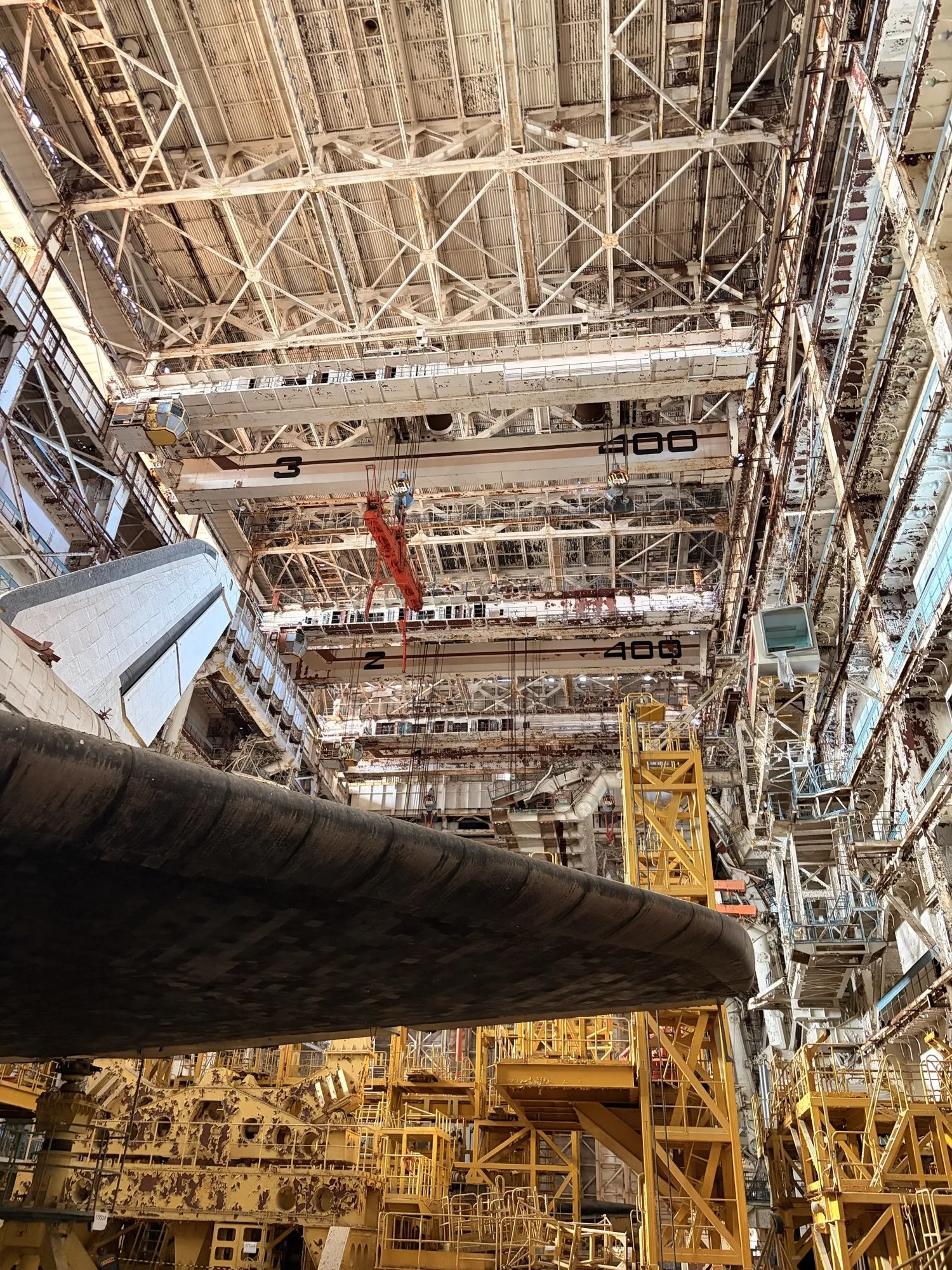
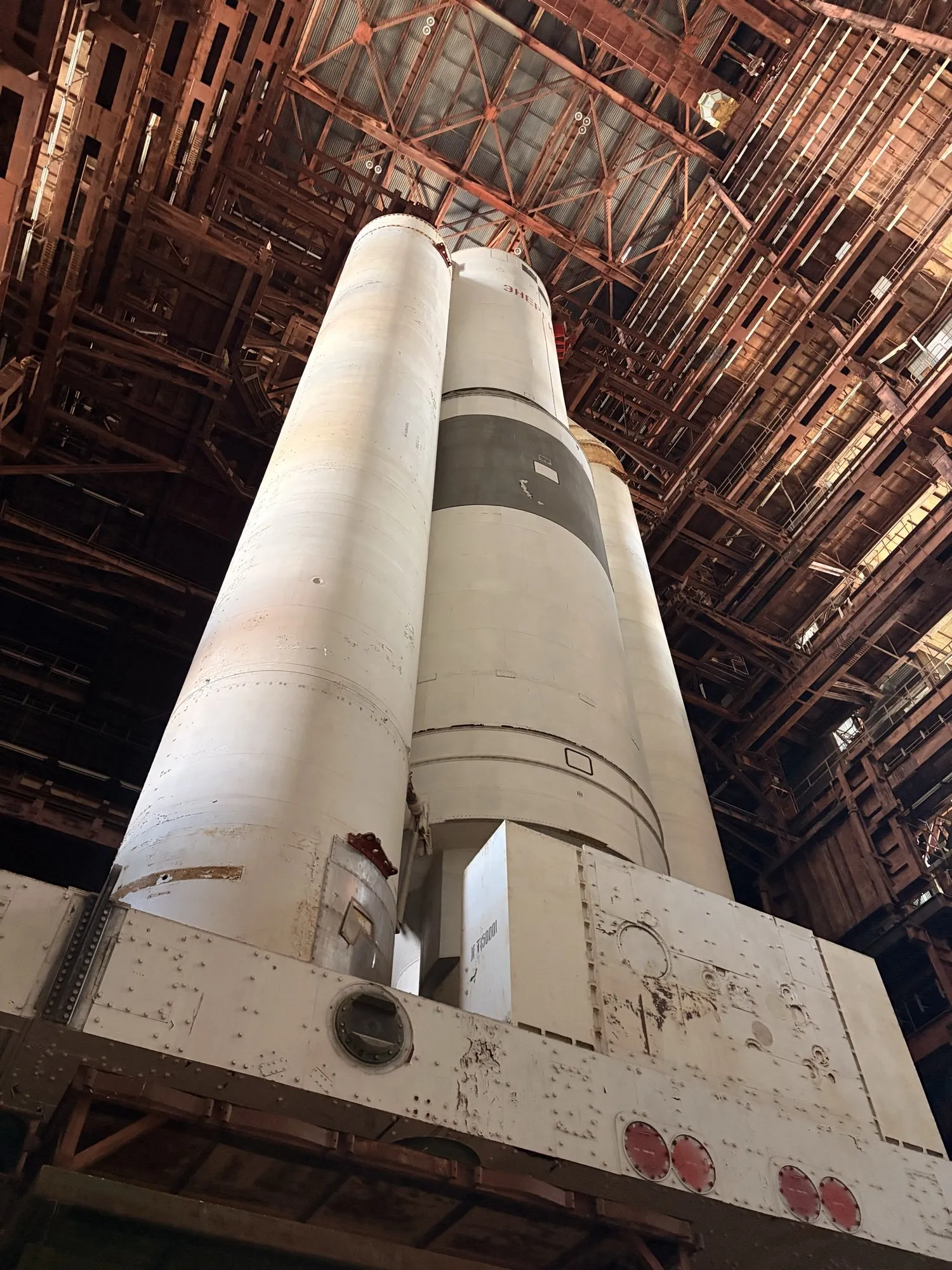
I had no idea what Buran was until I was looking at it. Buran was the Soviet space shuttle developed in response to the American Space Shuttle. Energia was the ginormous rocket designed to carry Buran into space. It was an extraordinarily sophisticated program, and seems to have been an improved design of the American Space Shuttle program. Energia launched Buran in 1988 without a crew; the shuttle orbited Earth twice, then landed autonomously at Baikonur. But by the 1980s, the Soviet economy was struggling, and its collapse ended the program in 1993, leaving all these enormous facilities and equipment abandoned at Baikonur.
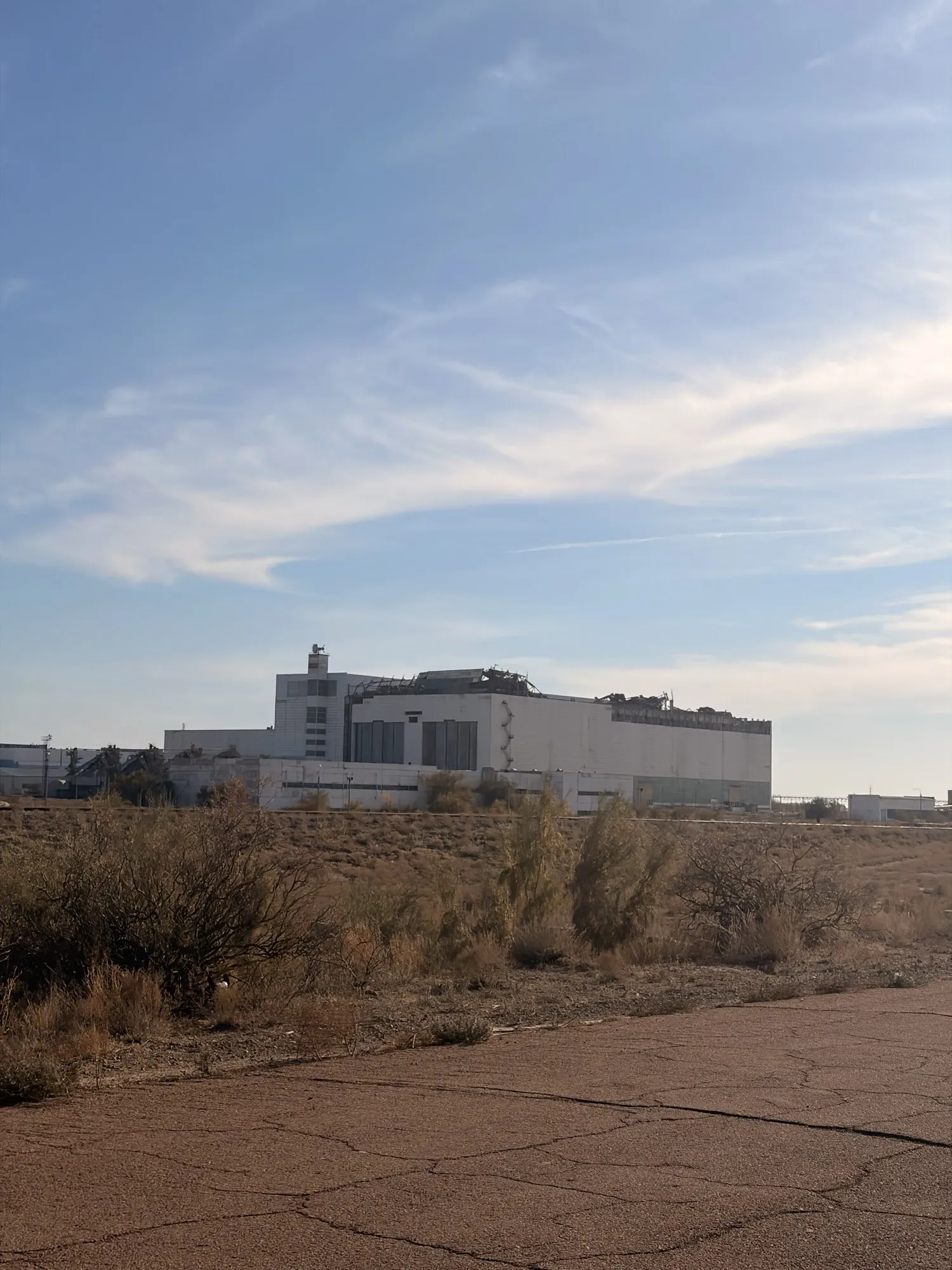
Generally, the world forgot about it until the roof collapsed at one of the facilities in 2002, killing eight workers, and destroying the only Buran orbiter ever to fly in space. The Buran survived space, atmospheric re-entry, an automated landing, only to be crushed by a roof on Earth fourteen years later. Its surviving brother, meant to become the second operational Soviet shuttle, was 95–97% complete when the program ended. That’s the one we got to visit.
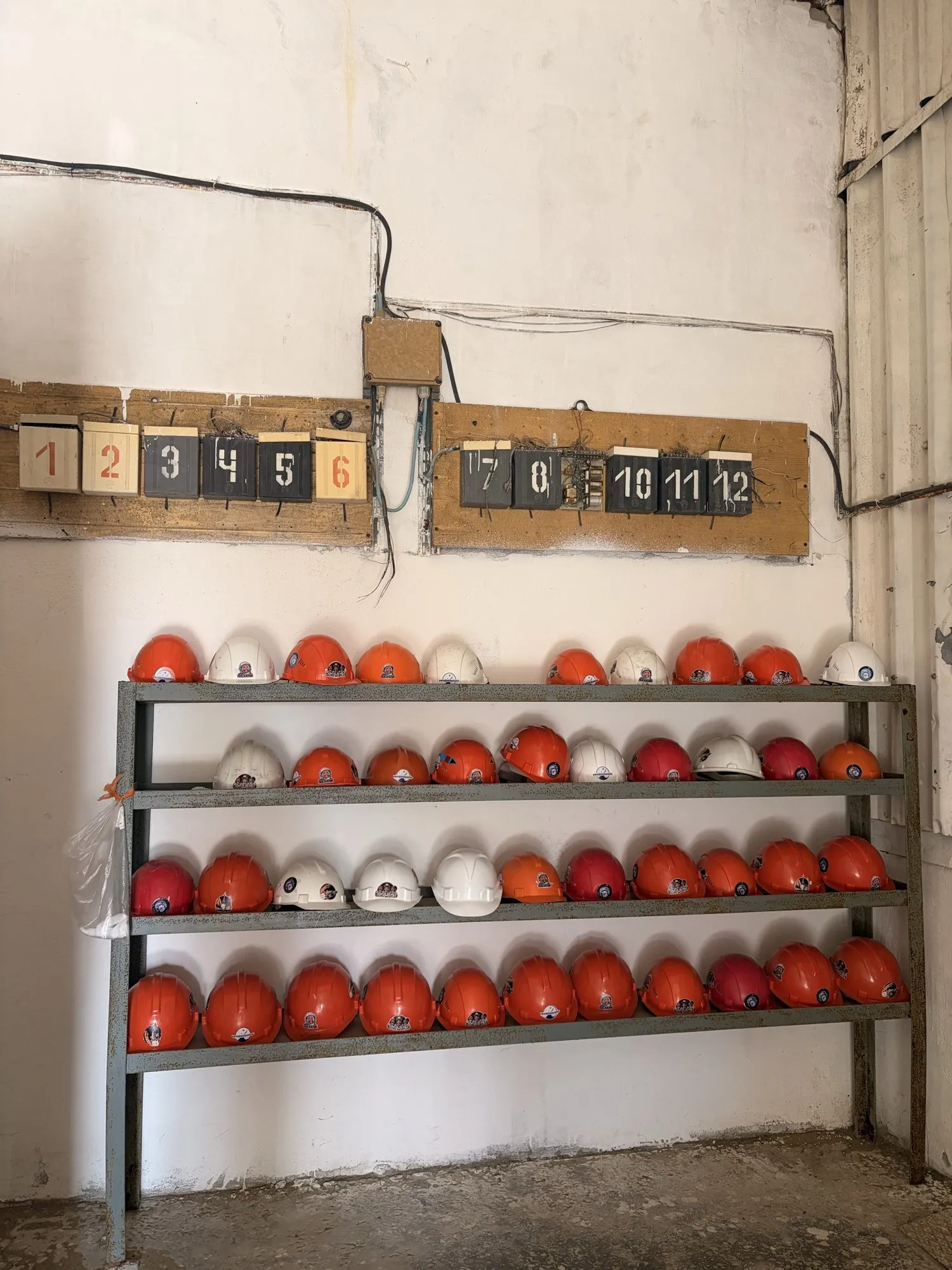
After driving by the collapsed roof at the original Buran facility, we arrived at the hangar. A nimble guard jumped out of a broken window, checked our documents, and gave us construction hats. We signed documents signing away any liability in case something fell on us, since the facilities haven’t actually been assessed by civil engineers since the 90s. It didn’t help that the other facility collapsed. As my guide joked: “the hard hats aren’t to save your heads, it’s to help find you in the rubble”.
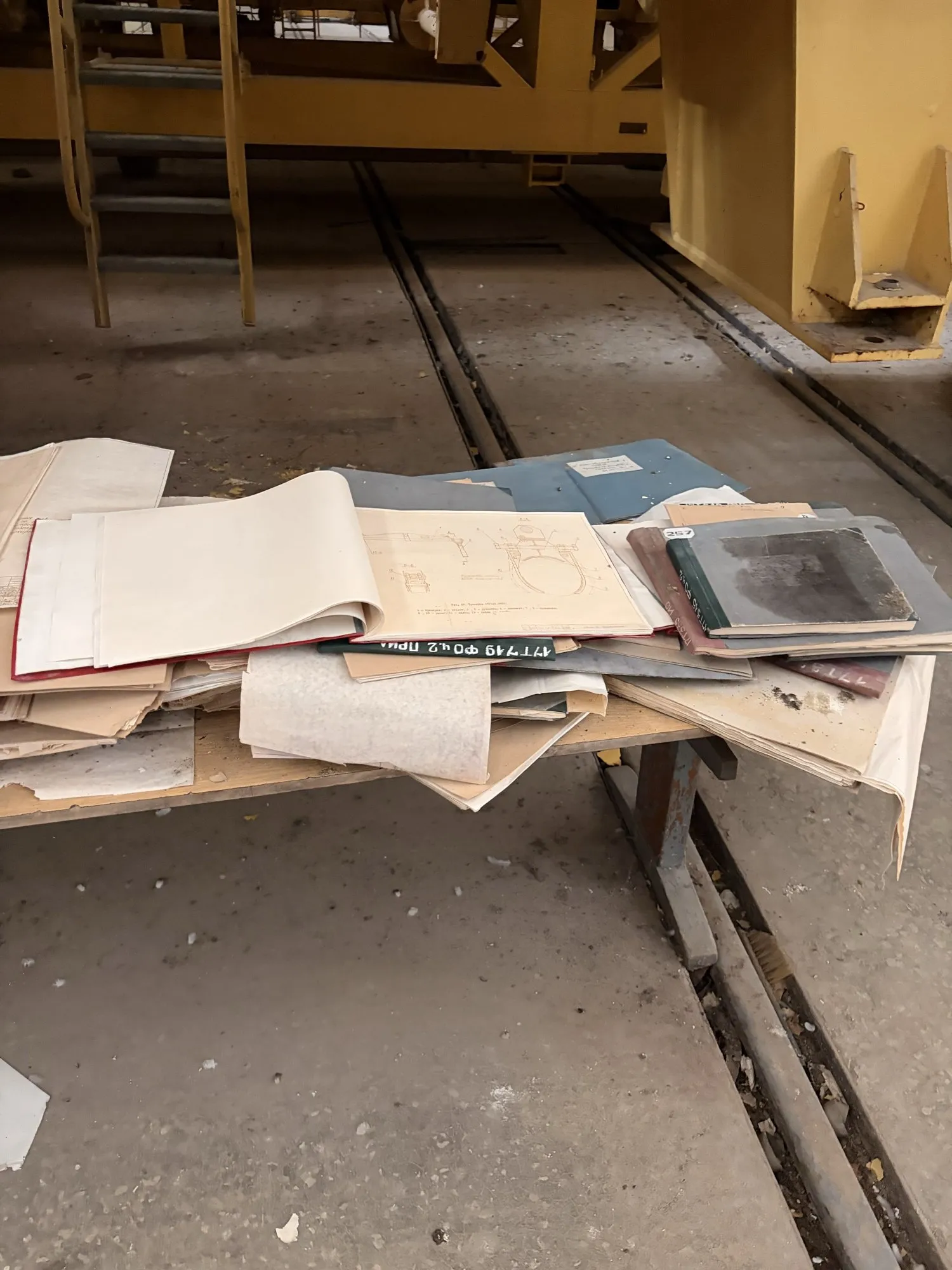
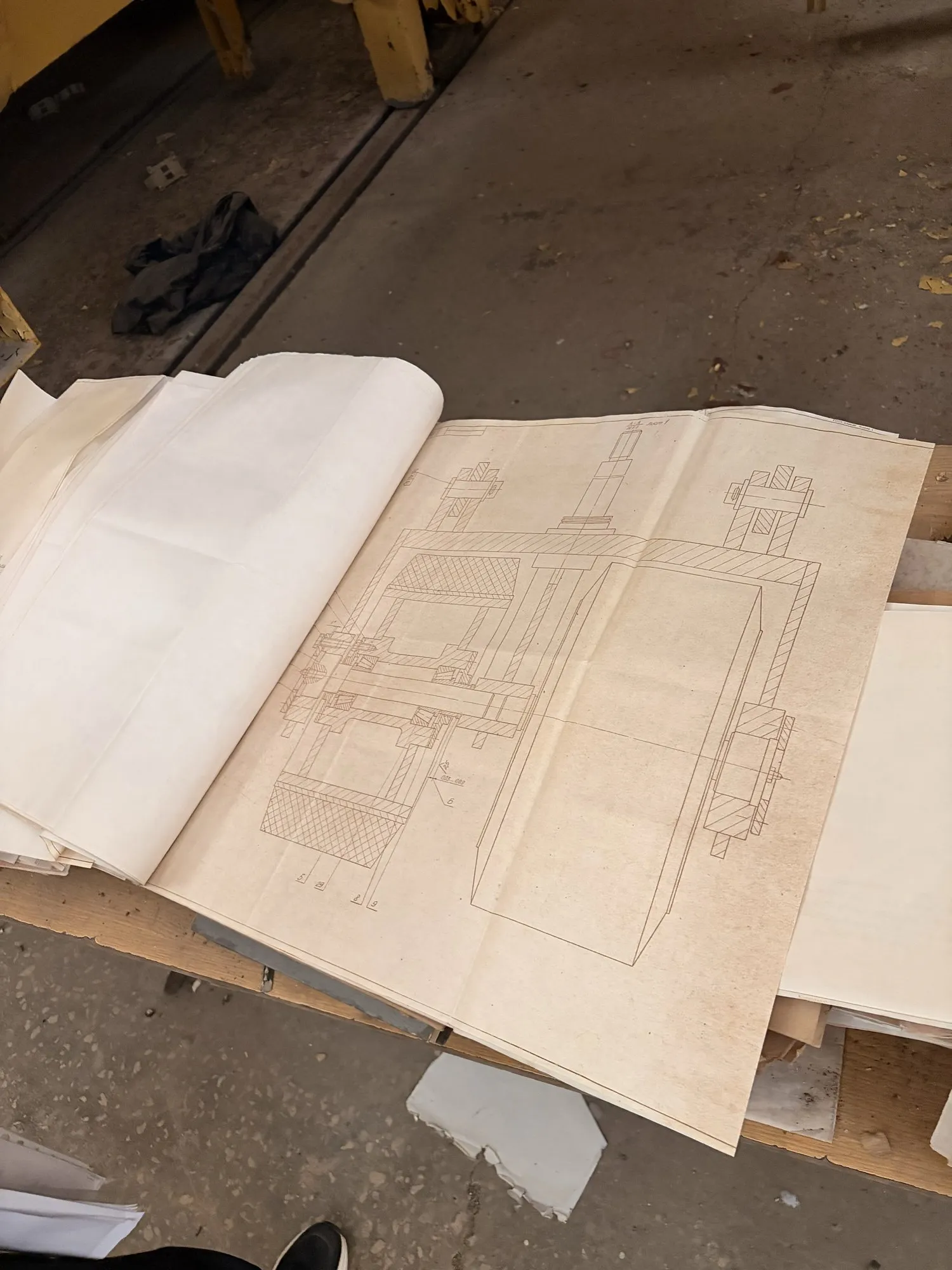
Videos and photos don’t do this justice. The shuttles themselves are incredible, but the building is just as remarkable. Strange contraptions hang above you, reminiscent of those tunnels that take you out of airplanes combined with sci-fi fantasy. Machinery used for assembly runs along the walls and ceilings. Scattered books and papers of its design lie on tables, giving us the opportunity to flip through the dusty blueprints. It’s eerie. As if everyone just vanished, leaving this moment as a decaying photograph. Birds have made a home in the top floors. Their coos sound like monster growls and alien noises, due to the mass echo. The facility has two planes: a mock-up for testing purposes, and the original surviving OK-1.02 intended to fly. The surviving plane has some of its heat-resistant covering missing, a consequence of raiders sneaking in and selling parts. Apparently, just one square plate sells for as much as a car.
The facility has a problem with what we call stalkers in Russian, people illegally sneaking in. You can even find vlogs of stalkers in Buran on YouTube. But to get there on foot takes days, and conditions are brutal. After a French tourist died from dehydration, the needle was pushed for the government to open these facilities to the public.
The Birdhouse
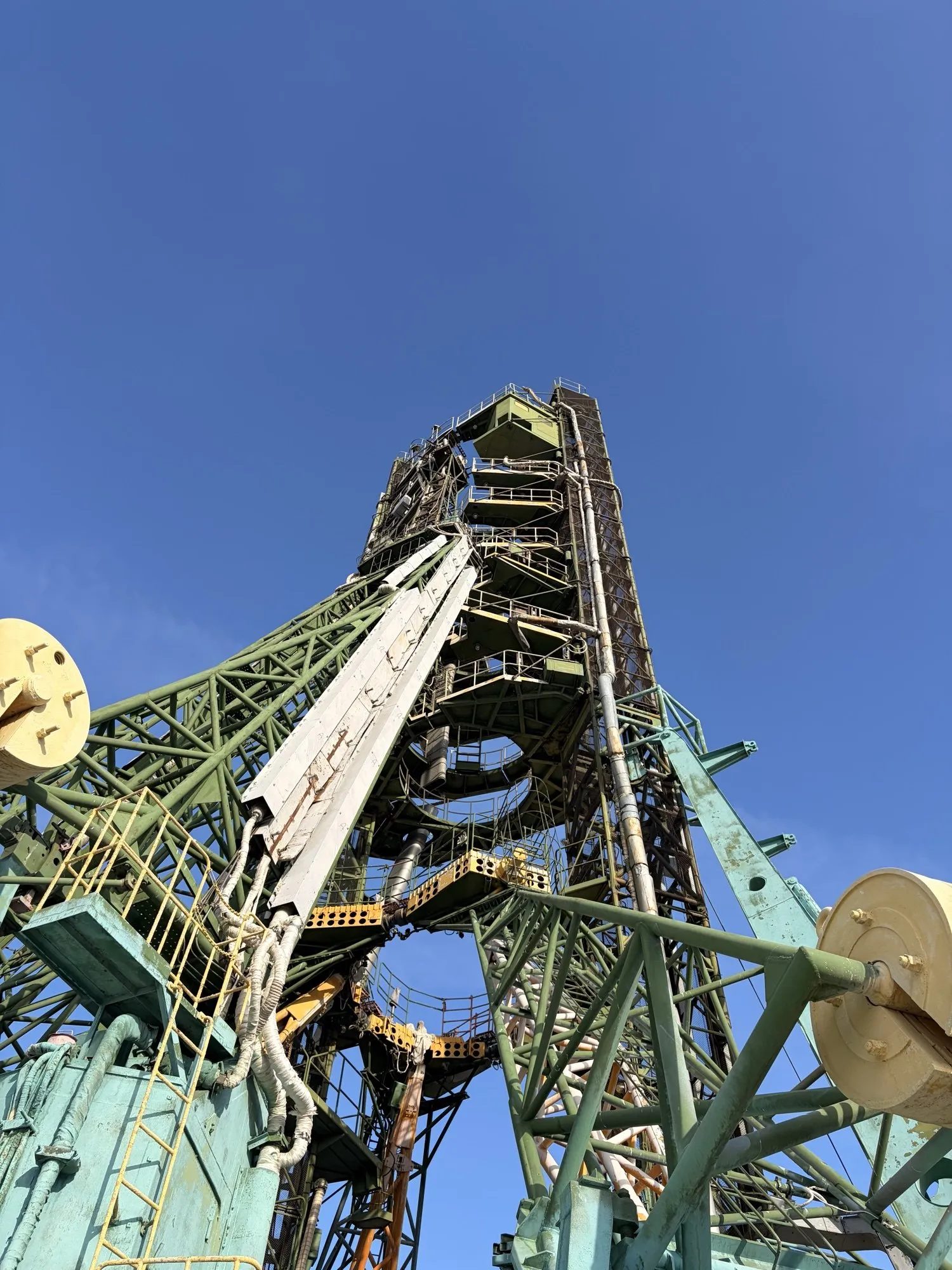
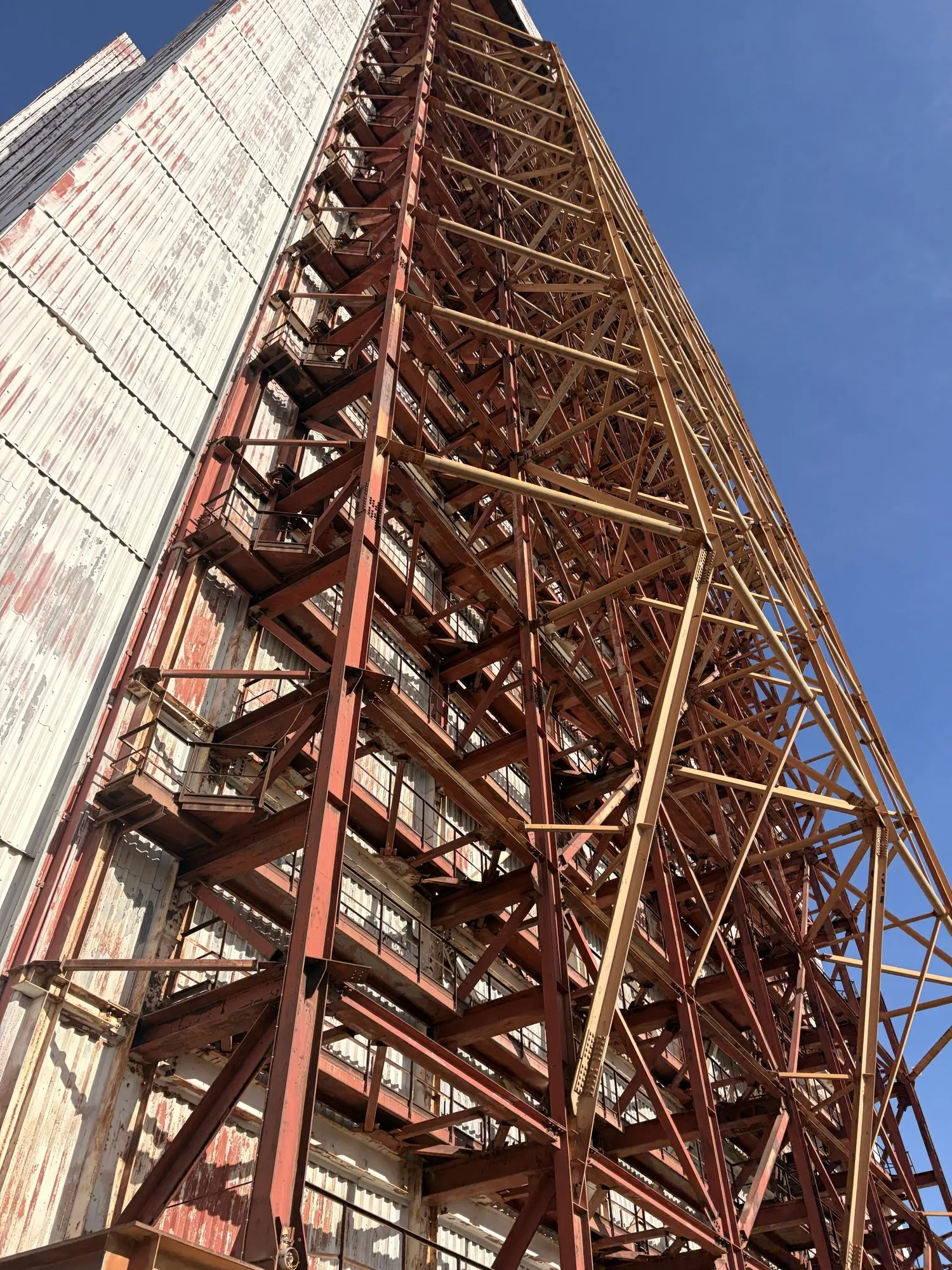
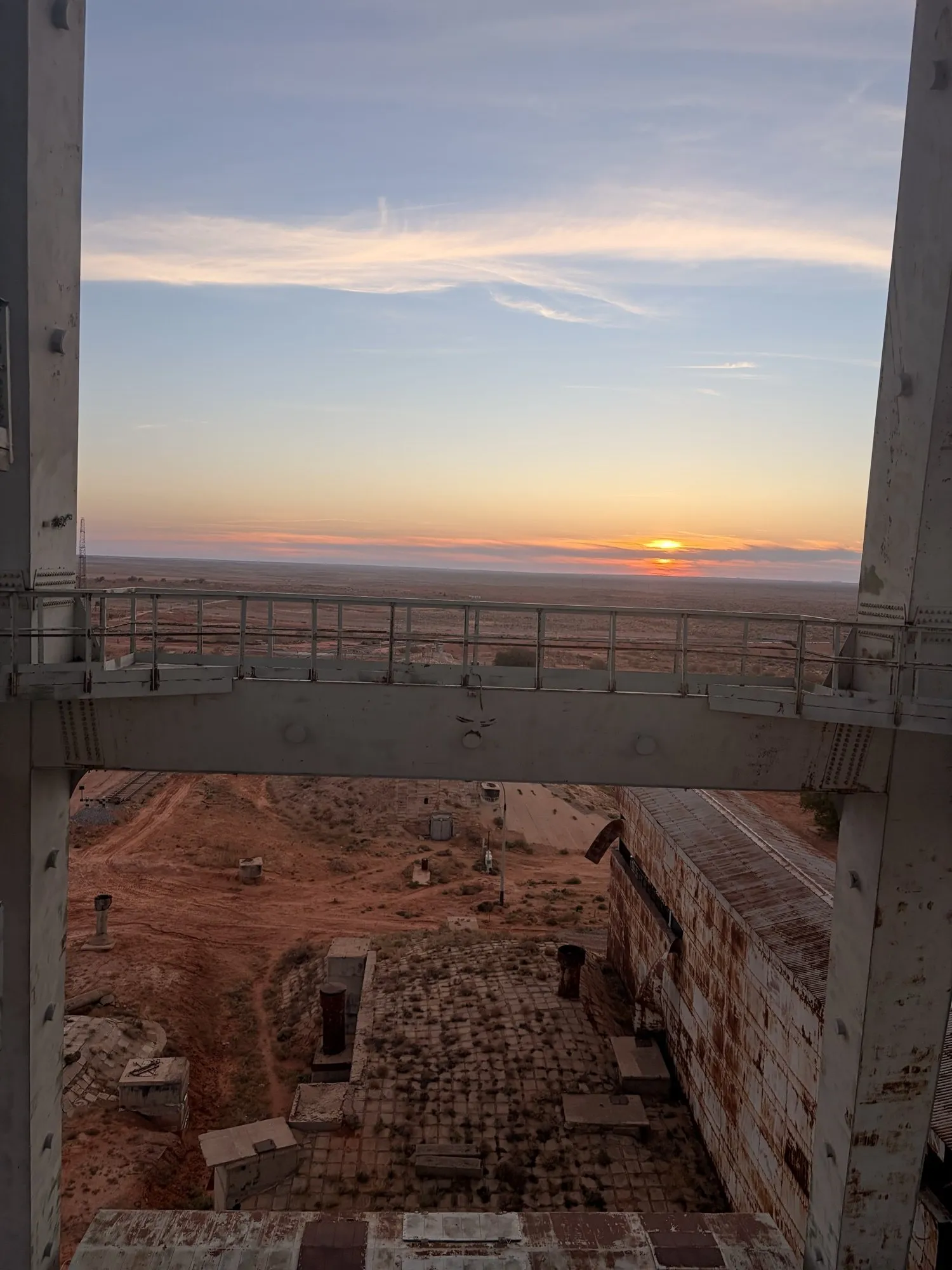
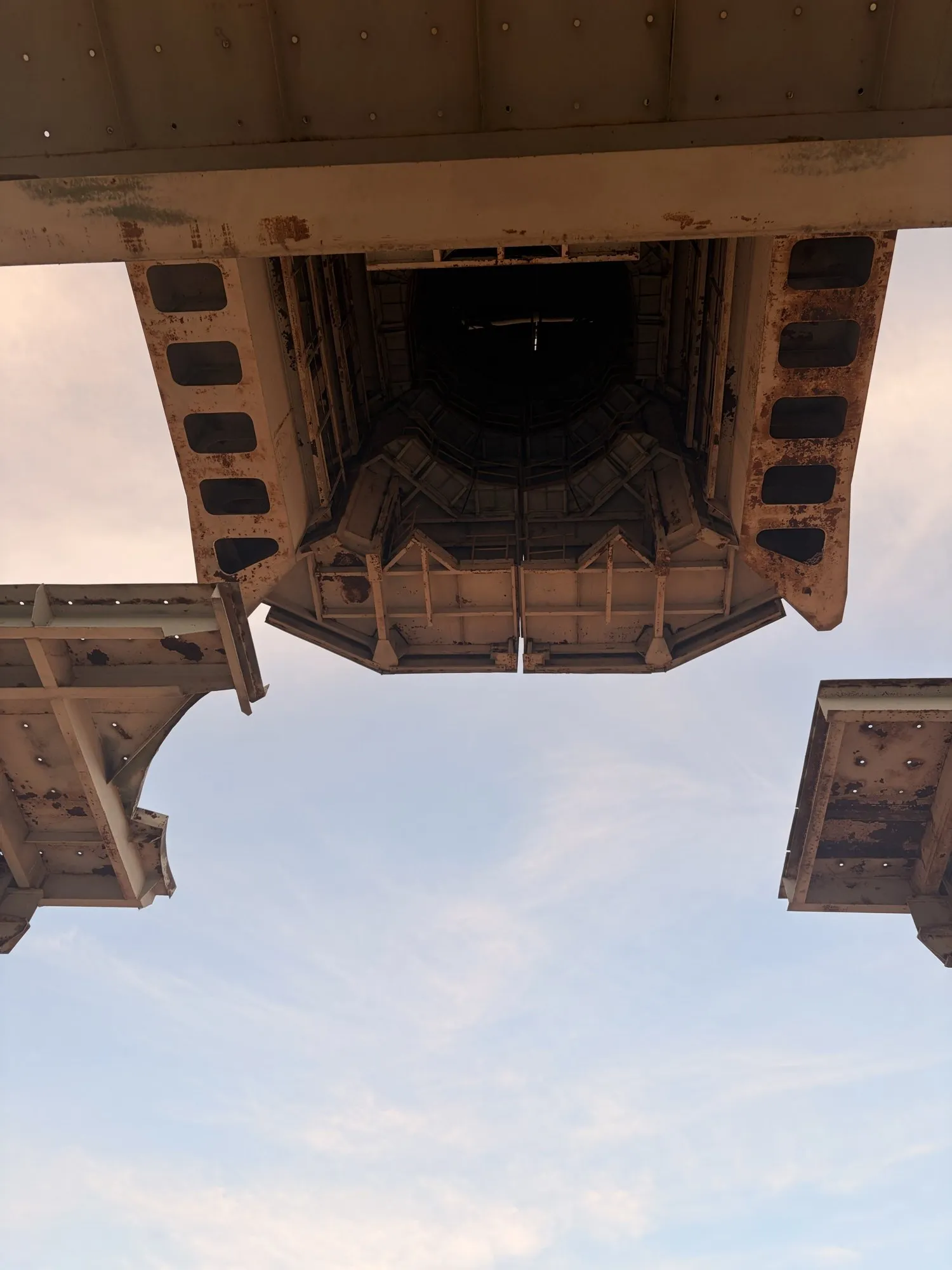
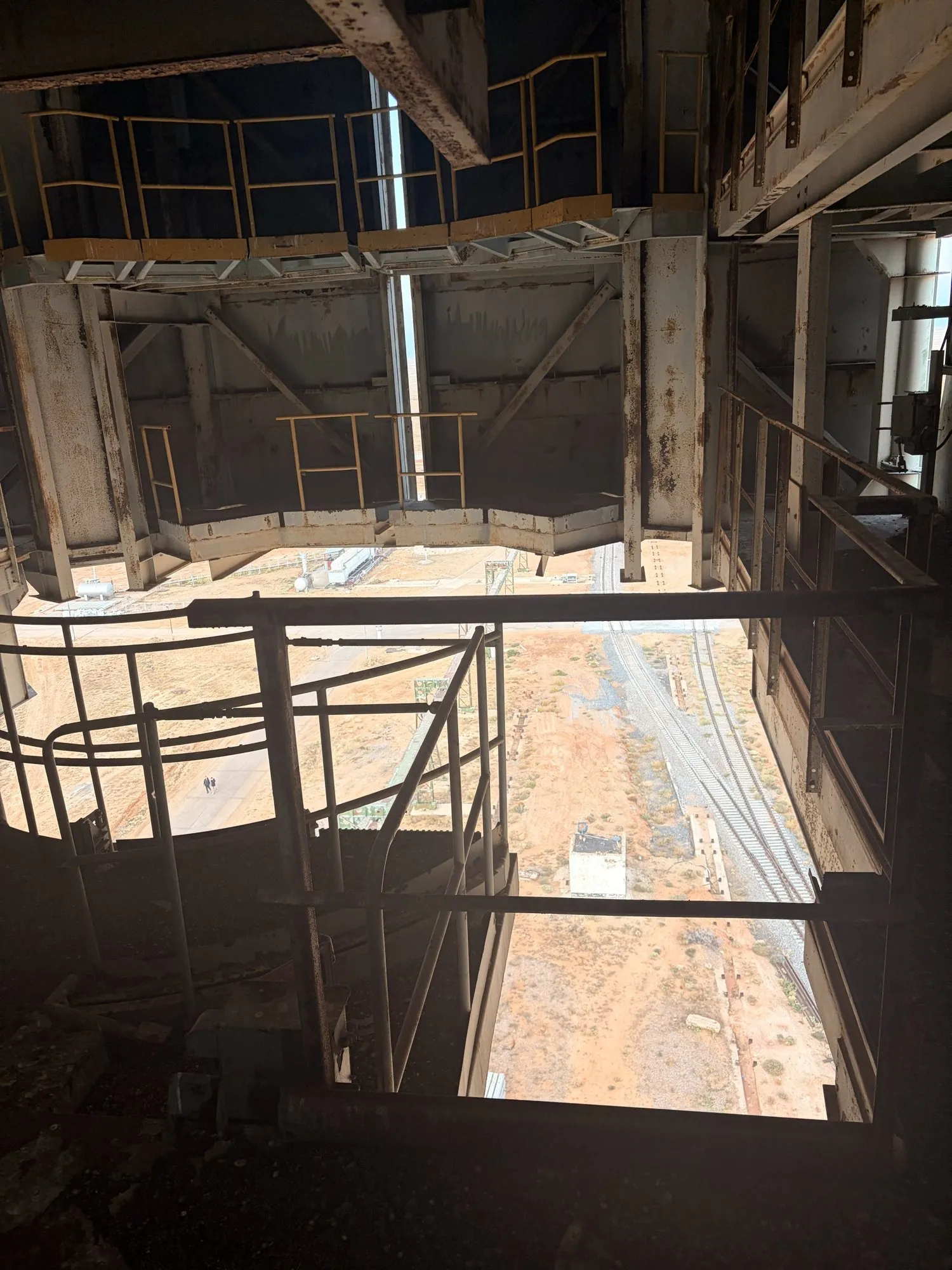
Last was a movable service tower built for the rocket launch pads, nicknamed “Skvorechnik” (Скворечник), or “Birdhouse”. Unlike conventional fixed launch towers, it could be moved into position via railways to provide technicians and astronauts access, before being moved away before launch. Two were built for sites 45/1 and 45/2 in the 1980s. The second one got destroyed when the rocket exploded at 45/2. The first one still stands there today, though not in use due to what Oleg called “incompatibilities with life”. This is a common saying in Russian, used to describe something dilapidated.
Climbing the birdhouse definitely pumps some adrenaline. The stairs were steep, rails were flimsy, and there were enormous gaps all around you, nothing stopping a sixty-metre plunge. Everything was rusted, creaking, and seemingly felt unsound. Unknown to me, the workers downstairs were placing bets on which tourist would make it to the top, the girl or the boy. Since I was the girl, most bets were against me.
We climbed it during sunset. Between the orange painting the sky, red steppes, howling winds, and launch structures, it was beautiful. Oleg pointed to where missiles were kept before their withdrawal in 1992, in a bunker right near the current active launch pad. Inside, the wind was just a whisper, as the “arms” that would have wrapped around the rocket were closed, hugging the empty space.
Exit
The next morning I had some more porridge, had my luggage checked again, got signed out of the cosmodrome, and started my long journey back. I had complicated feelings. I think the history of Kazakhstan and Baikonur is still raw for much of the population. But I’m thankful for the opportunity to explore, feel and leave.
Do I recommend?
It was an incredible trip, but not one for everyone. My only other companion was a Brazilian, and I could tell some of the culture shock and language barriers took their toll. Although many tourist agencies advertise proficient English, the reality is, it helps to know Russian or Kazakh. At least for the time being. As mentioned, these guides are Baikonur workers doing this part-time. I do think it could still be an incredible trip, even with the language issue, if you plan it during a launch. Baikonur has some arguably lax safety rules, allowing for some of the closest viewings of rocket launches. I’ve heard a live launch is a once in a lifetime experience.

Names have been changed for privacy.